Category Archives: DIY

Installing mains water sub-meter and auto–close valve linked to Home Assistant

Updated 17 February 2026

Jump to Home Assistant Details

This blog covers the installation of a sub meter between the house and Anglian Waters boundary meter, the blog on locating this pipe can be found HERE.

The primary reason I want to monitor my water consumption in real time, is that Anglian Water supplied smart meter can’t do this as the App is typically 24 hours behind, a secondary reason is that I can take the opportunity to add an automatic shut-off valve linked to Home Assistant, so should a leak detector activate in the kitchen, the water supply to the house will close and also an alert will be sent to my mobile.

The equipment will be installed a standard size irrigation valve box.
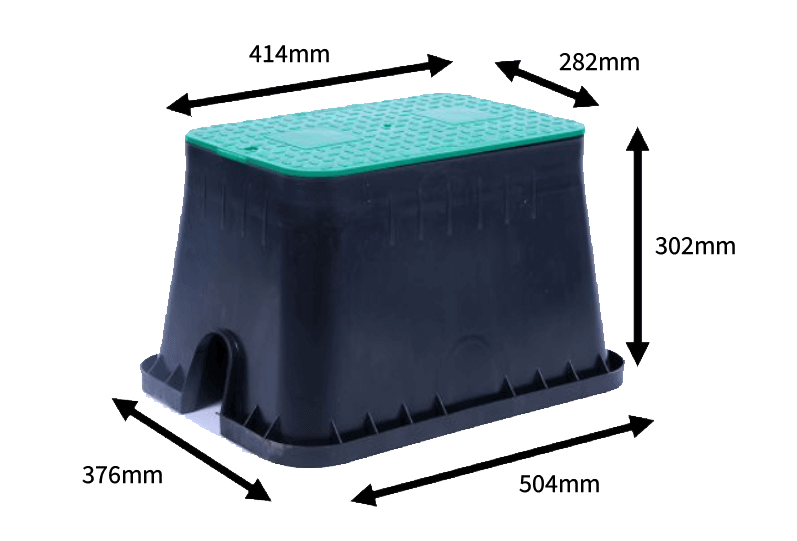
valve box

The original idea was to install the valve box as near to the house as I could in order to reduce cabling and ensure a decent Wi-Fi signal gets to the control system, this idea failed when it was discovered that the water pipe near the house id over 1.5m deep.

The next best option was to place the valve box in the hole I’ve already dug near the boundary meter which was used to trace the pipe.
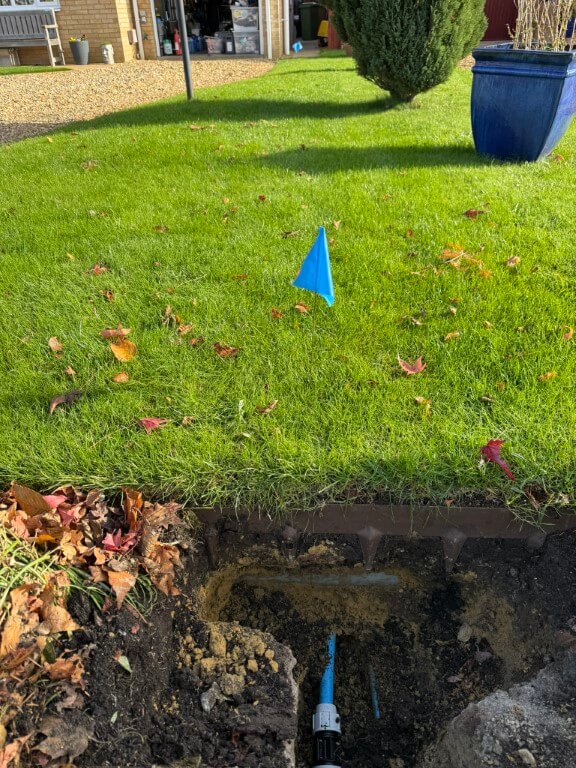
boundary dig

This plan was to install the meter and valve inline with the pipe with the valve box sitting over the top of the kit, impinging slightly into the lawn.

This came to a halt when I uncovered an Openreach duct under my lawn with the water pipe passing under it, so the only option left to me was to put the valve box just past the blue flag in the lawn marked in blue.
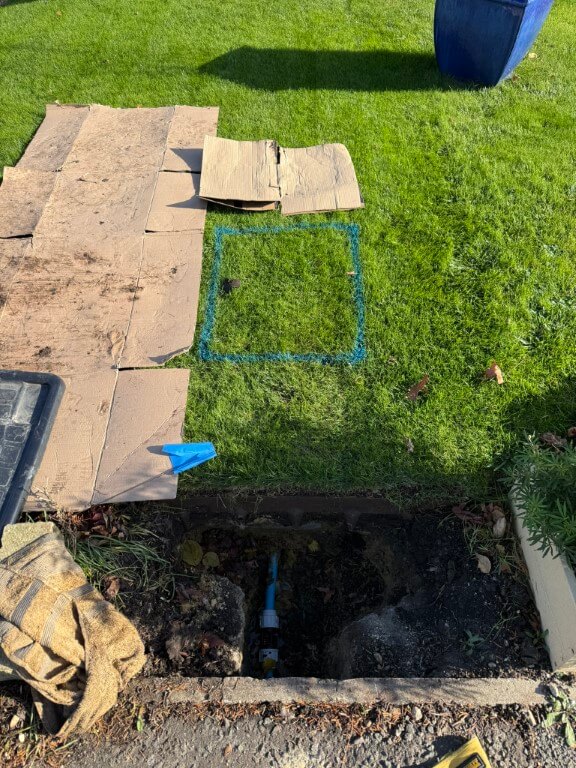
marked hole

The dig went quite well, I was aware of the garden irrigation pipes which pass to the right side of the dig and also in front of the box.
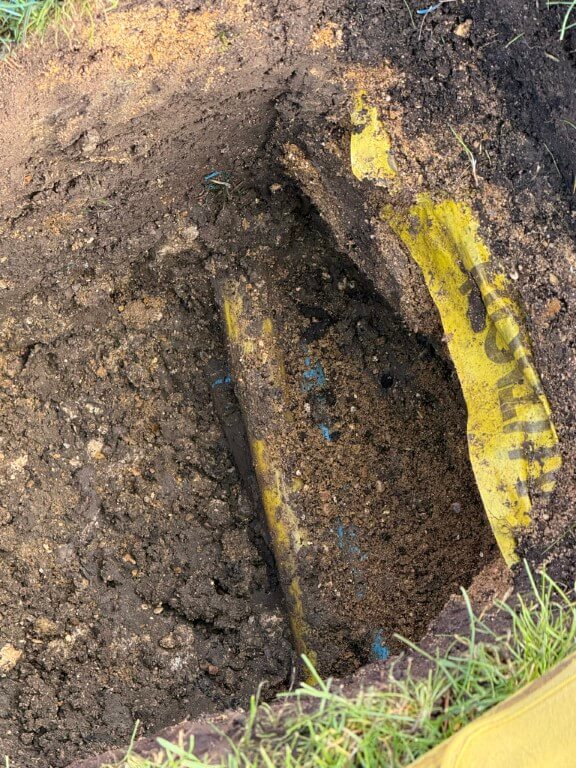
first hole

Typical with this project, I discovered the expected water pipe, but also the gas pipe and further down, the electrical duct to the house, all basically touching each other and off-center in relation to the valve box.
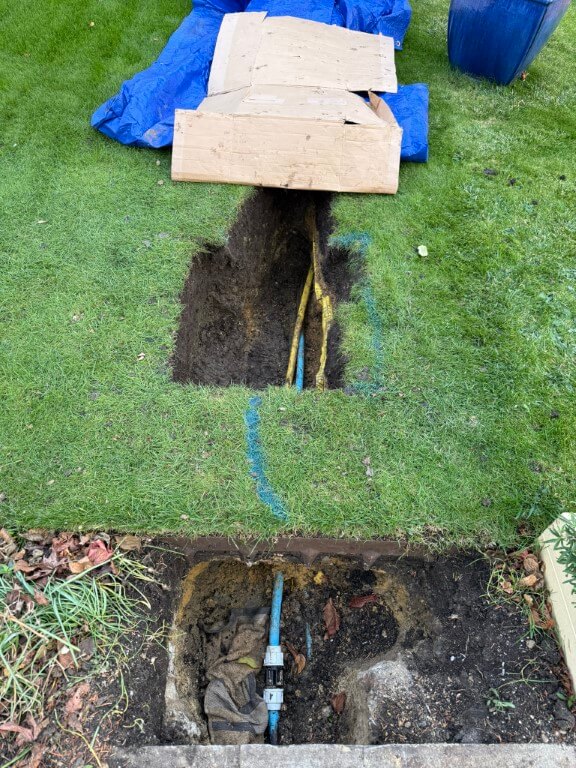
dug before box

Due to the lay of the pipes I moved the valve box dig slightly to the left, this meant I needed to reposition the inlet and outlet water pipes.
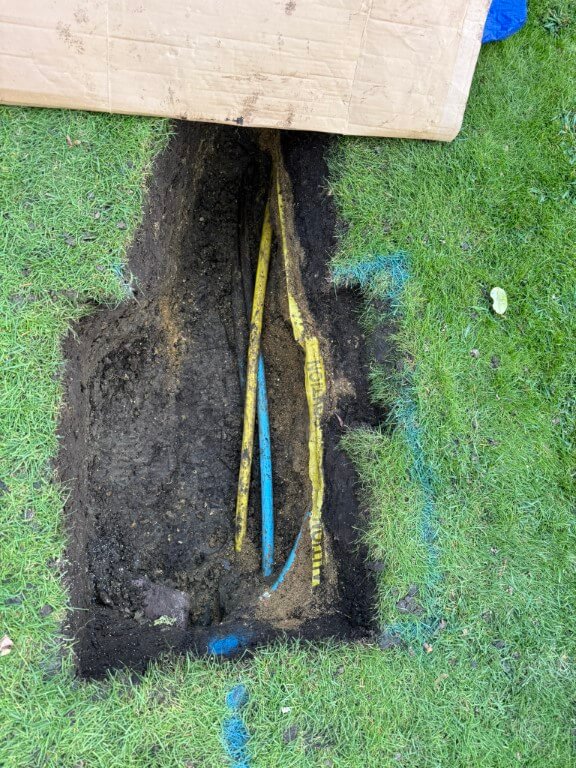
zoom hole

To compound the issue, the water pipe feeding my property is underneath the gas pipe, the close up on the above finished dig showing the irrigation pipe with marker tape, below this are the gas and water pipes.

I dug further back to give me better access to the water pipe, also the length will give me additional flexibility, the plan is to cut the water pipe and get it from under the gas pipe so it will enter the valve box in the correct position, also the existing pipe to the boundary meter will be removed at the slip coupling and rerouted to the left of the existing position, again to get the pipe central in the valve box.
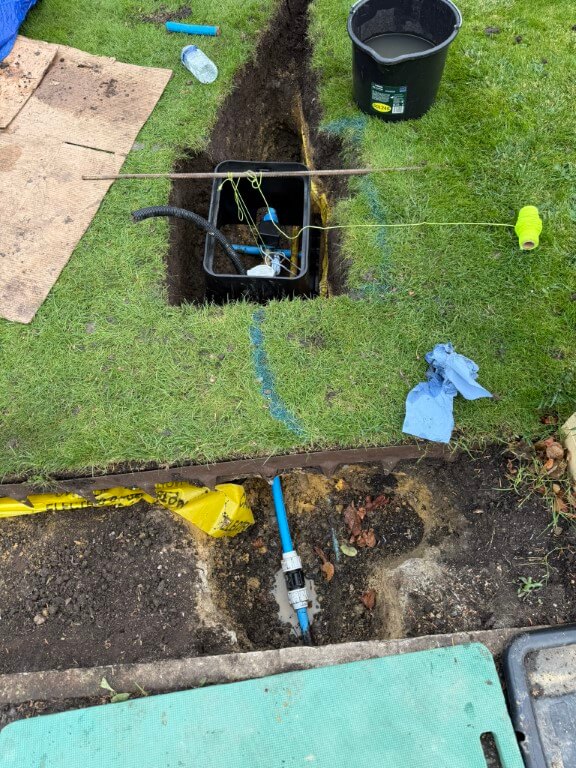
box start

Valve box in temporary position after water connections made, the water connection turned into a problem for me as the pipe from the boundary meter under the grass to the new hole had been compressed and deformed to an oval shape by the Openreach Duct pressing down on it, with a stone beneath the pipe, a perfect storm.

The meant that I had to hammer the pipe through the soil from the slip coupling, only to find that I needed 1m of 25mm pipe to replace the damaged section, fortunately Taymor Plumbing Merchants at March were brilliant and cut me a piece for free, I did go back with chocolates and a Thank You card as they got me out of a right pickle.

The 25mm flexible conduit is to carry 12v power to the ESP32 which controls and reads the valve and meter respectively.
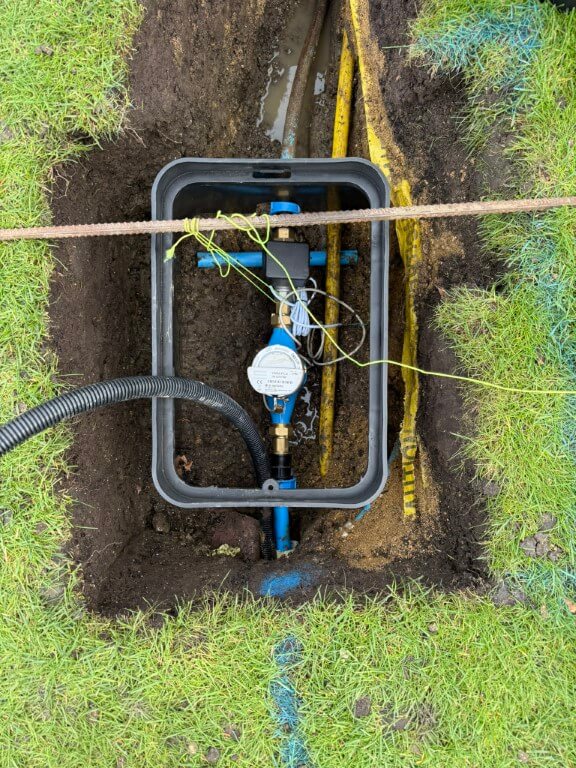
valve box top

New pipe from slip coupling to sub meter via protective sleeve, exit pipe from the auto-valve to the house no longer under the gas pipe, making for a tidier install.
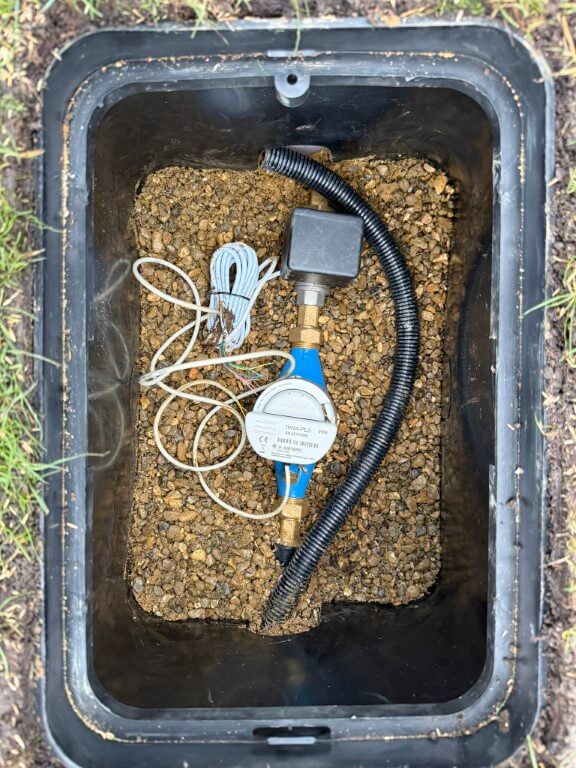
meter in place

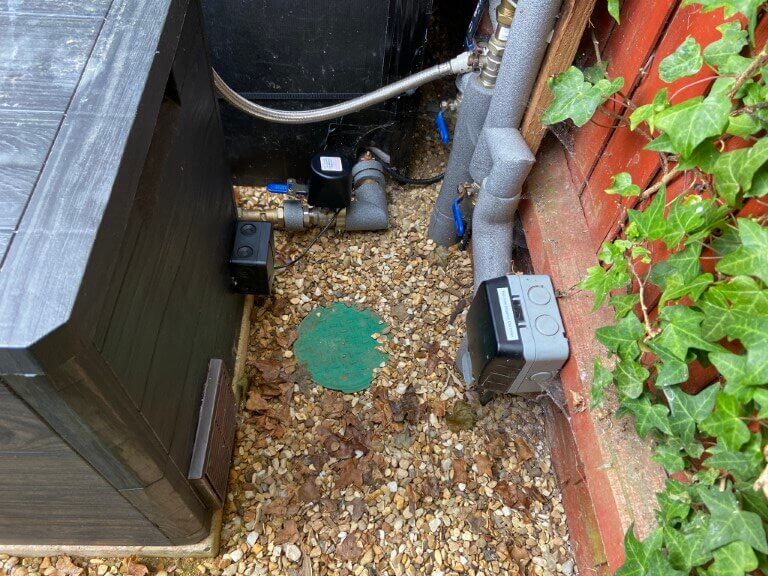
Valve box fixed in place with pea gravel and leveled to the grass, water pipes covered in builders and sharp sand to protect them and the longer section of exposed pipe to the house had pipe insulation fitted before being covered.

As I have pipe ‘fixed points’, the water meter is on flanged couplings allowing easy removal, I have also used a brass male to male cone seat union on the auto-valve, again to allow easy removal and replacement when required.
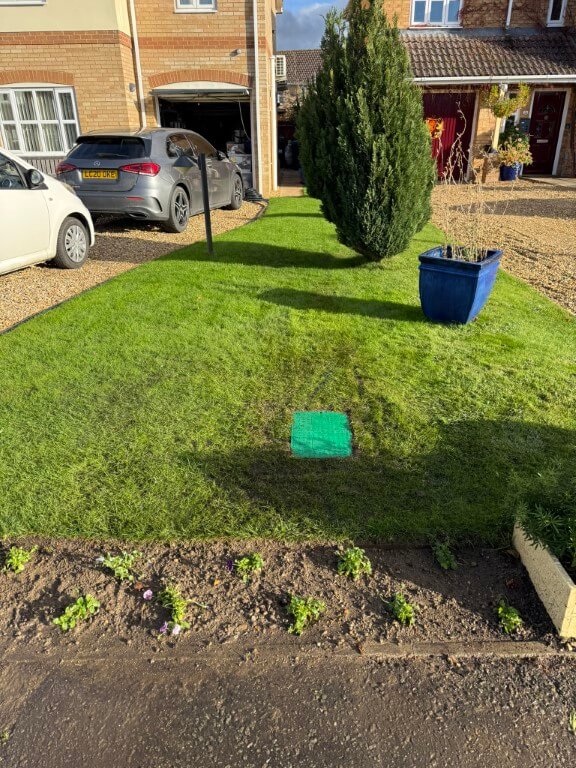
box lid

Grass and border restored to make the job look a lot neater, once everything starts to grow, the box lid will melt into the lawn.
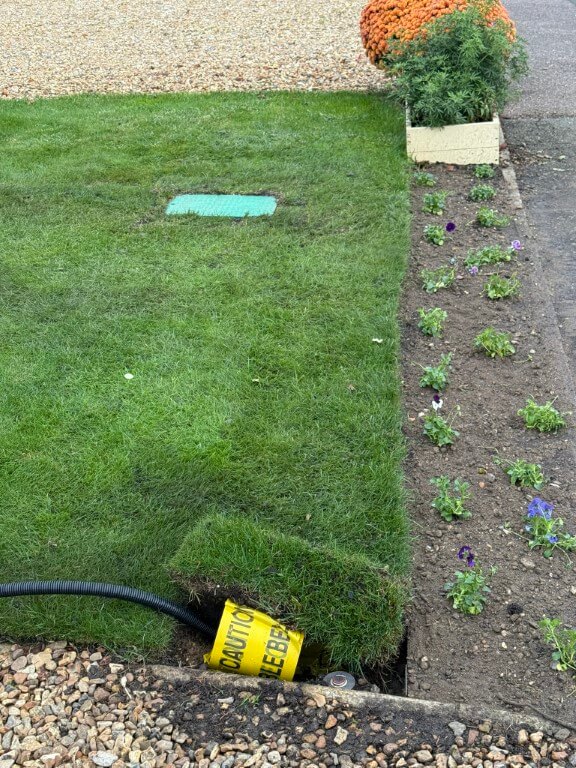
conduit

25mm Flexible conduit being installed back to the garage, the conduit has a marker tape over it and a shallow covering of sharp sand, due to concrete haunching supporting the round nose edging, the conduit is quite shallow, but I I wont be aerating the lawn this close to the edge, so it will be fine.
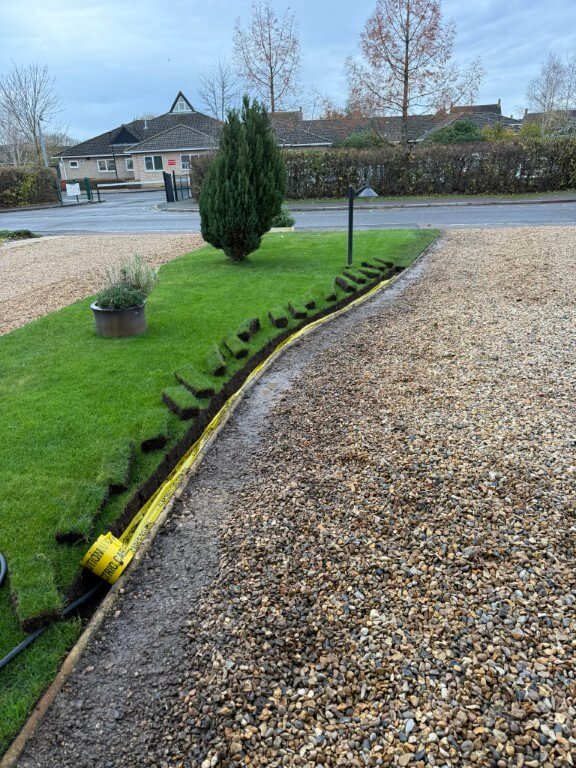
conduit going in

As it had been raining recently, the grass sods were easy to cut and lift out.
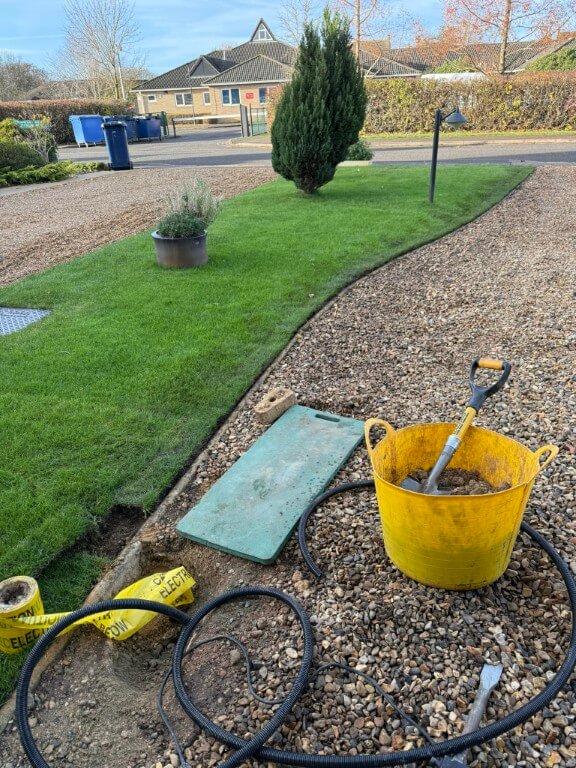
lawn edge

Conduit under the edging ready to drop in a trench in the drive which is yet to be dug, the last sod of lawn is next to go back and levelled down with the back of a spade, after that a mix of sieved soil mixed with lawn seed will be spread down the cuts and joints of the lawn where I have worked.
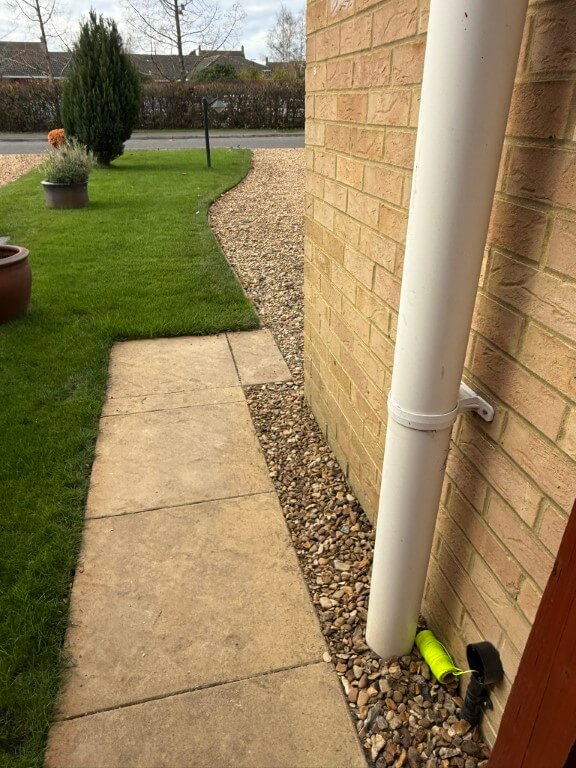
finished conduit

Flexible conduit all installed and draw cord in place ready to pull in 1.5mm2 two core cable for the 12v DC power to the ESP32.

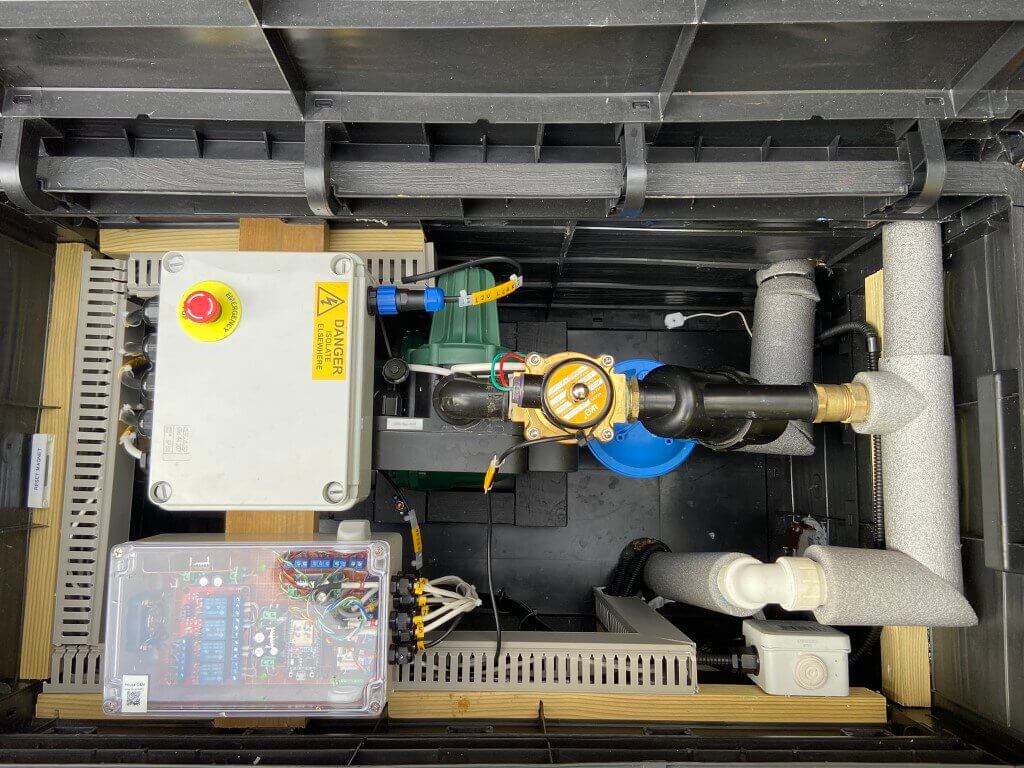
In the meter pit I have installed an cover for the equipment in the valve box using 50mm Kingspan insulation.
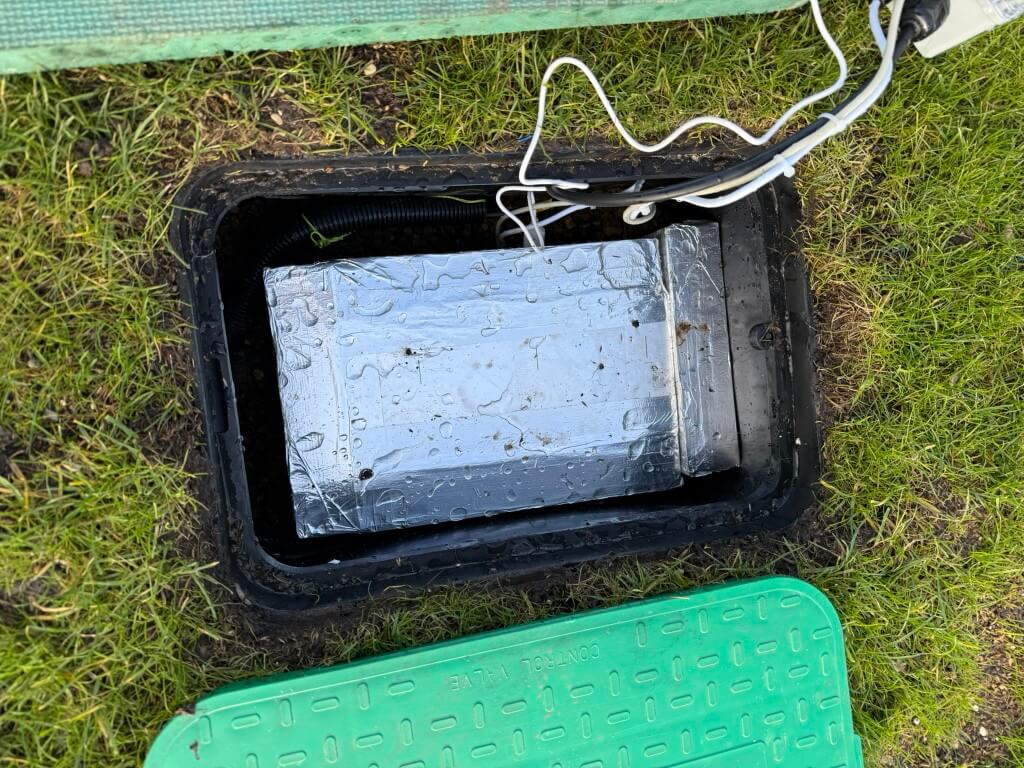
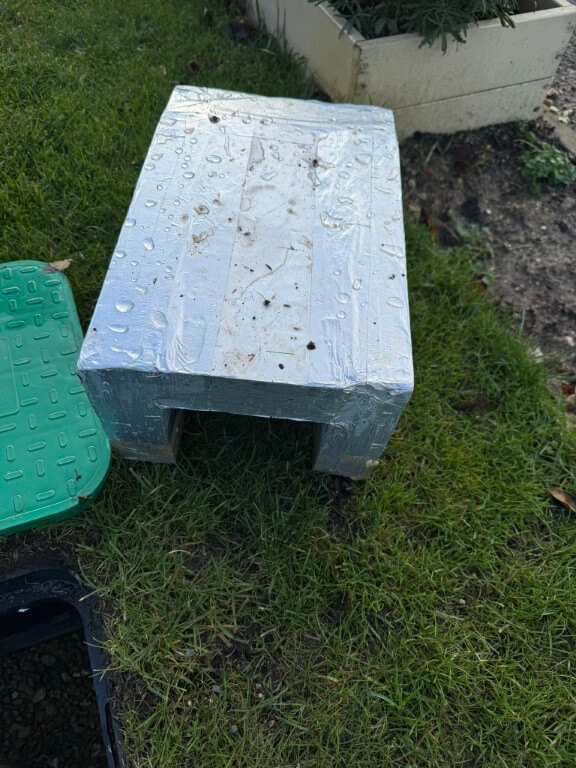
Home Assistant interface, equipment and wiring

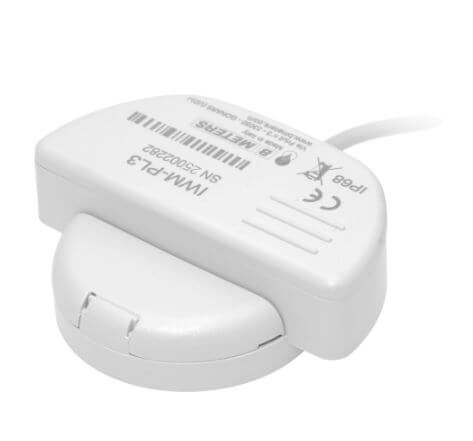
Working from the boundary water meter owned by Anglian Water, the connection was made in 25mm MDPE to my sub-meter which is a BM Meters model GMDM-I with a IWM-PL3 pulse emitter fixed to it and configured to register 1 pulse every 10 litres, both of these were bought from stockshed.
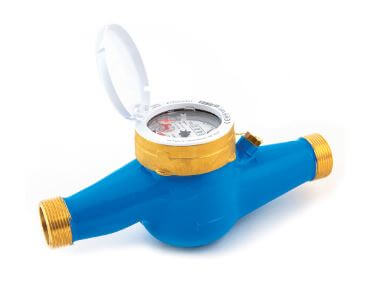
After the sub-meter is the automatic isolation valve, this is a ‘full bore’ valve so as not to reduce the water pressure to the house, (both the sub-meter and valve are 3/4″).

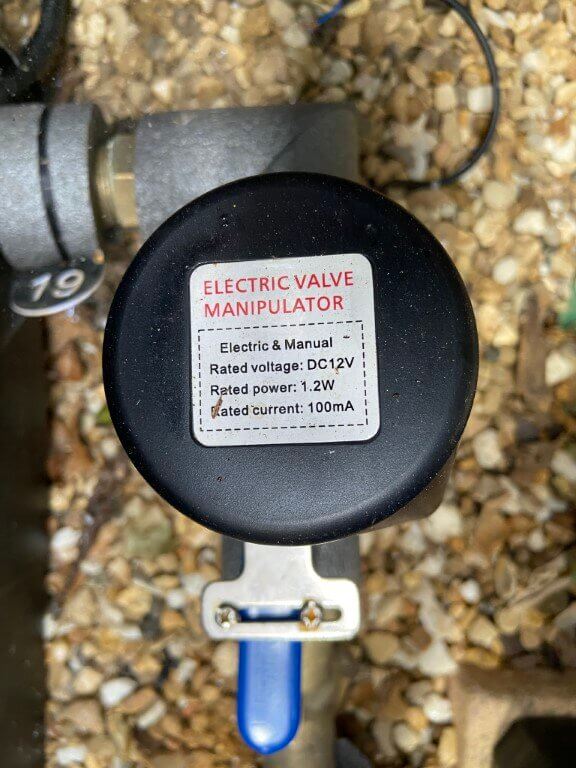
The automatic valve was bought from solenoid valve world, I opted for a version that monitored if the valve was open or closed and had the ability to be manually fixed open.
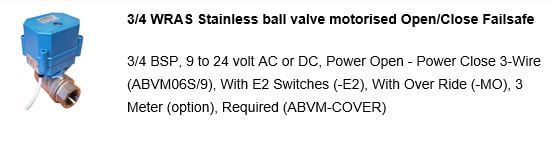
auto valve

The valve operates on 9 to 24v, in my setup I’m using a 12v DC power source. My configuration is 12v permanently available to the valve and to close the valve, a switched12v hold open positive is removed, to open the valve, a 12v positive is reapplied to the control input.
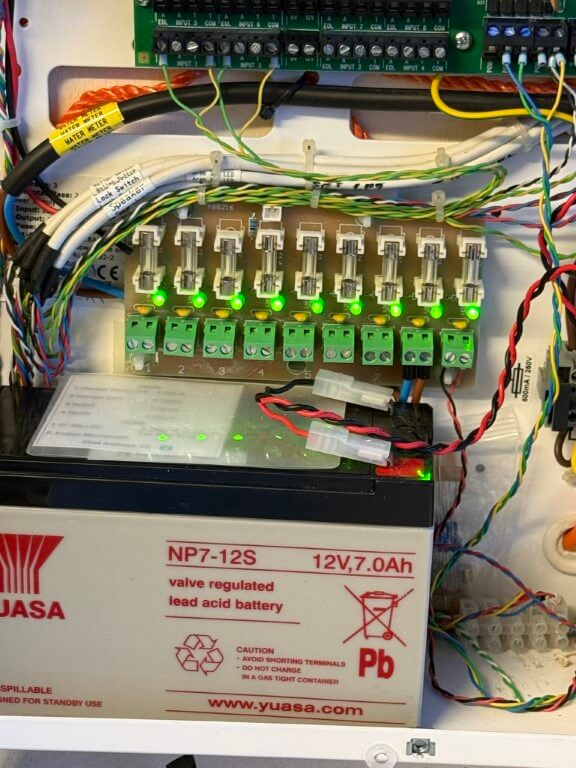
12v

12v DC to the ESP32 and valve are via a separate fuse from my home alarm system power supply as this is battery backed up.

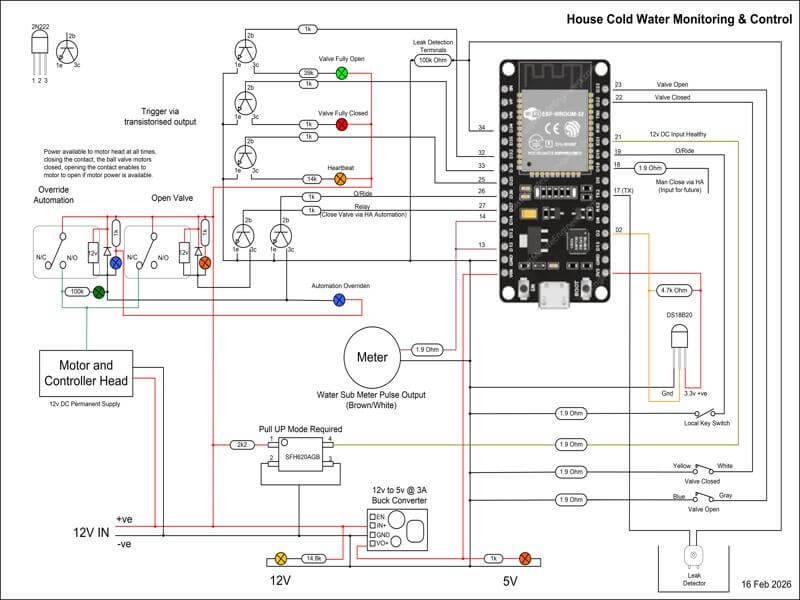
The valves position and operating commands are via an ESP32 connected to my Home Assistant dashboard by WiFi.
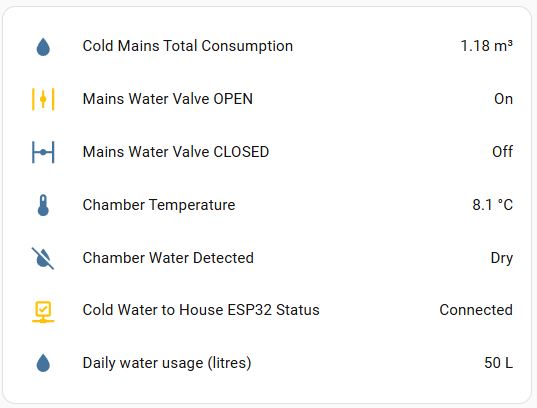
dashboard

To enable future maintenance when dealing with two fixed pipe points, I used a 3/4″ male x female brass union end on the auto valve, this means I can easily remove/replace, either the meter or valve should the need arise.
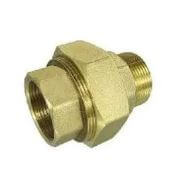
TB76 34

ESP32 Controller

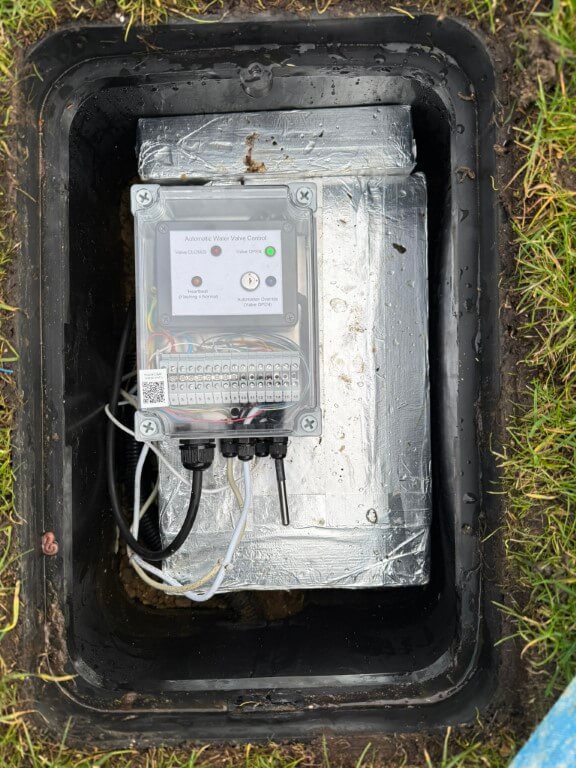
completed controller

The above picture shows the completed controller boxed inside an IP68 rated enclosure, all cables pass through compression glands in a hope to reduce moisture ingress.

The QR code is linked to my ‘Home Manual’ on my local NAS, this enables rapid access to anything related to this project.
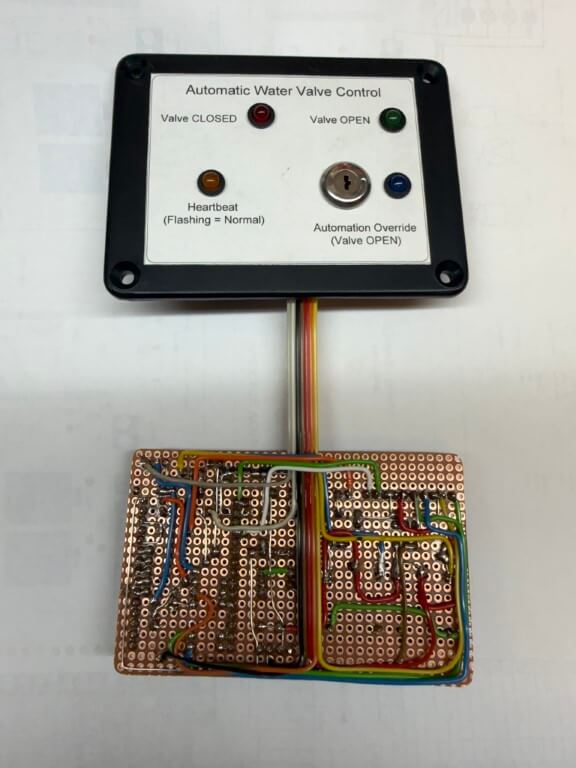
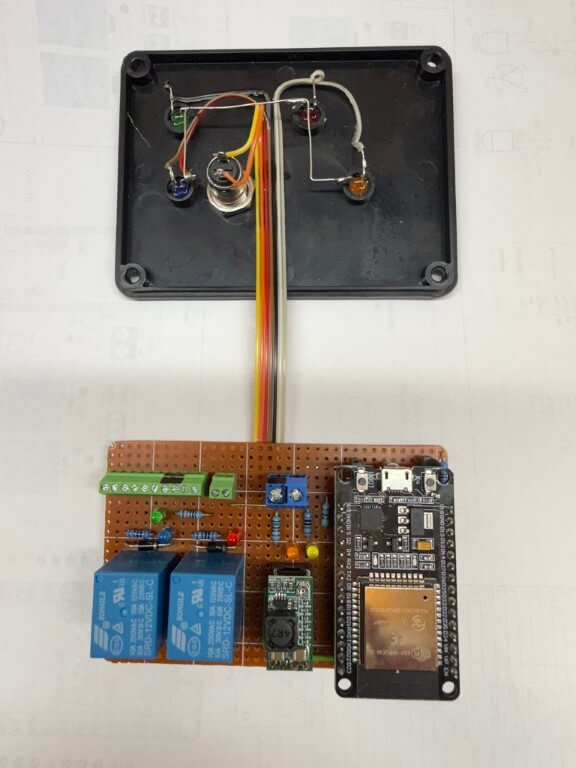
The ESP32 is the brains of the project, performing monitoring and control the following information to Home Assistant:

  • Auto-Valve position
  • External Temperature
  • Meter/Valve chamber – Dry or Wet
  • Remote override enable (to prevent any automations closing the valve)
  • ‘Heartbeat’ (power and WiFi connection are ok)

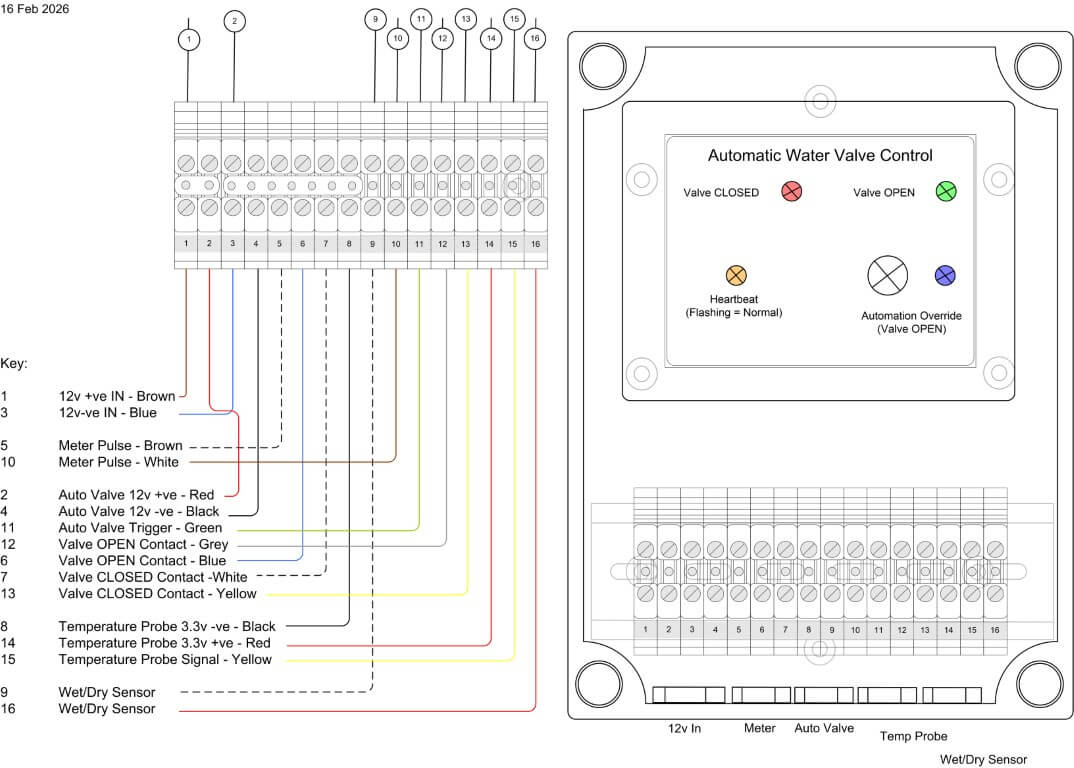
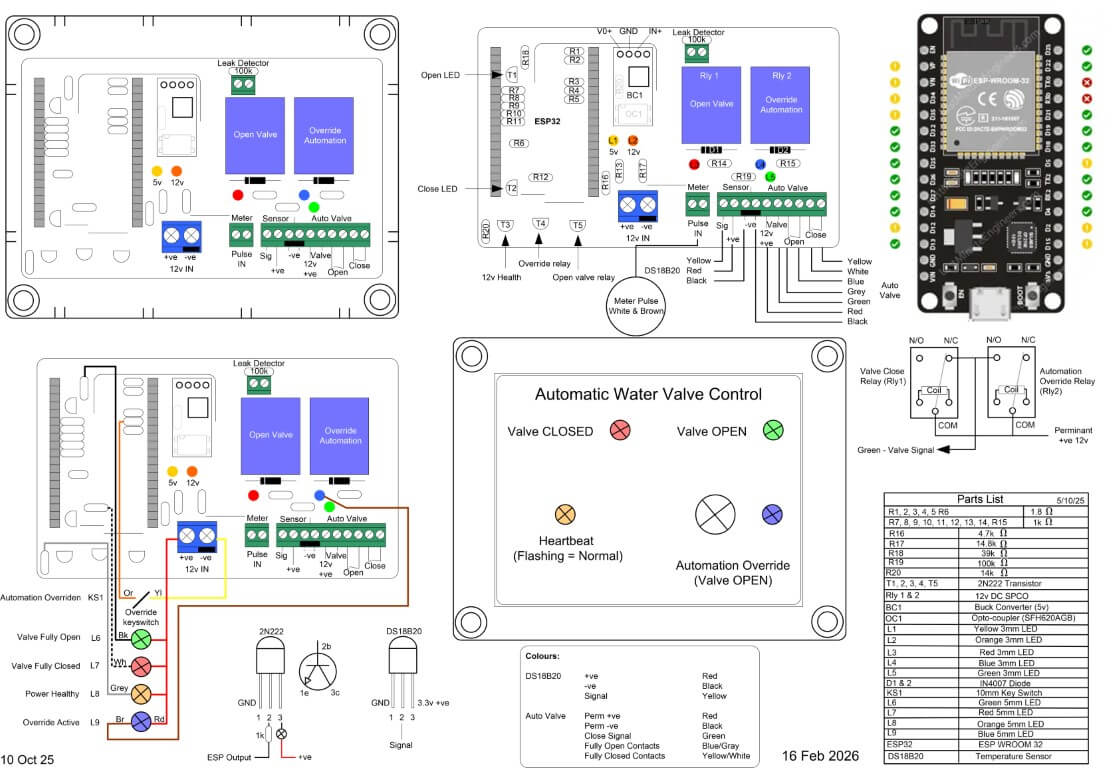
The first version of the controller was within a smaller IP rated enclosure, with field cable terminations made directly to the terminal blocks, however, the practicalities of doing this meant that it would be very difficult to easily remove the controller if maintenance was needed, therefore, version two used a larger IP enclosure and external terminals.
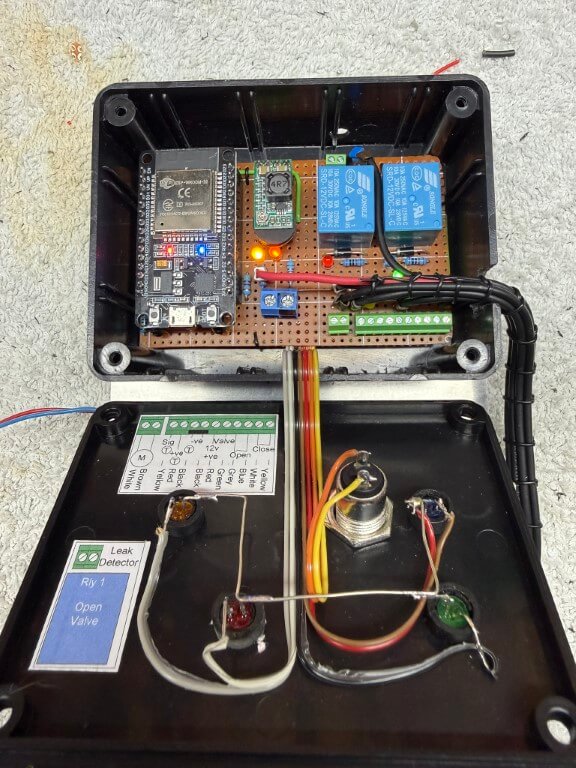
loomed controller

For ease, I simply soldered cables to the underside of the existing terminals and loomed the cables to DIN rail mounted terminals.
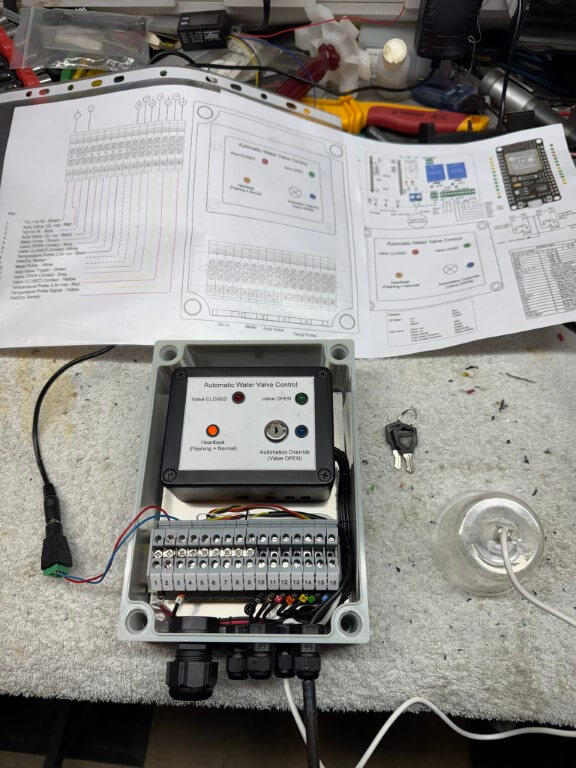
Under test

Completed controller within enclosure undergoing testing, the temperature probe for the chamber is fixed to the enclosure, to the right of this is the moisture detector secured inside a plastic cup.

The mouth of the cup will sit on the gravel base of the chamber with the height of the sensor set below the automatic valves motor and electronics, an alert is sent to my phone if moisture is detected.

The following files are of the wiring and code used:

I’ve only got a small amount of tweaking left to do, but essentially the project is finally finished as information and control is flowing to Home Assistant.
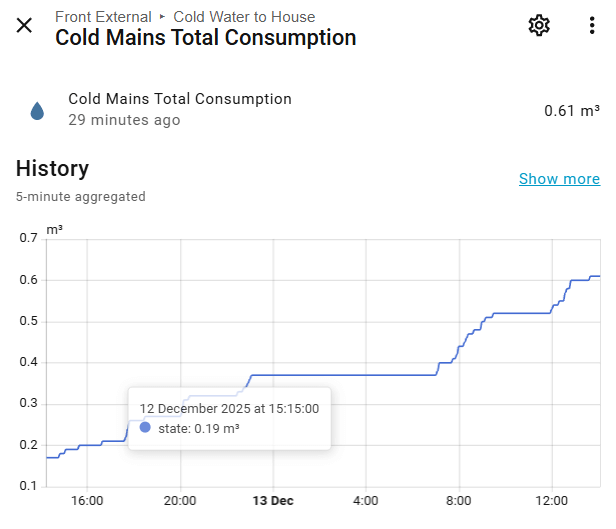
One of things to resolve is getting the Total Consumption value to align with the boundary meters reading, although not absolutely necessary, it would be a nice to have.

After a few months in use, I noticed when the chamber started to fill with rain water and the water sensor operated, the indication to Home Assistant was rapidly turning on and off, to combat this, the YAML code was changed to make the water sensor turn on just before a reading was taken and then off, this also reduces probe corrosion, a futher modification was to add filtering and water detection sensitivity.

I hope you’ve enjoyed following this, a typical example of what seems a fairly easy job, turning into a bit of a pain with lots of ‘re thinks’ along the way 🙂
Citroen C1 Dashboard Indicator Not Working

Updated 24March 2025

Background

A couple of weeks before the car was due for an MOT the indicators lights on the dashboard started playing up, the following blog is how I quickly sorted it, if I had more time, I would have used less bright LEDs.

Apparently this is a common problem with Citroen C1 where the indicators work, but the dashboard turn lights either do not work or become intermittent.

Like most people I went onto YouTube and the issue pointed to the steering wheel stalk switch which I duly bought from eBay, and after watching more videos on how to change this, I was very please with my efforts until I tested it and the issue was exactly the same!

How to Diagnoise

  1. Do both dashboard indicators come on when the Hazard Warning button is pressed and are they both stable when lit.
  2. If the dashboard lights are OK with the hazards but ‘flakey’ with the indicator switch, the problem is the steering wheel stalk and a replacement is about £18 and you will need a pair of bent long nose pliers.

Their are loads of YouTube videos on how to change the column switch and watched this excellent explanation: https://youtu.be/H3MQ8Ixwxow?si=G4r32EeSE6jmonJg

3. If the dashboard turn lights do not light at all or flicker or go very dim, this means the LED in the display cluster has failed or is failing, this was the case with me.

Instruction on stripping down the dashboard and changing the LED is here: https://youtu.be/vcVhkZm-138?si=Tqc9dxZNZn5V3RX5

Repair

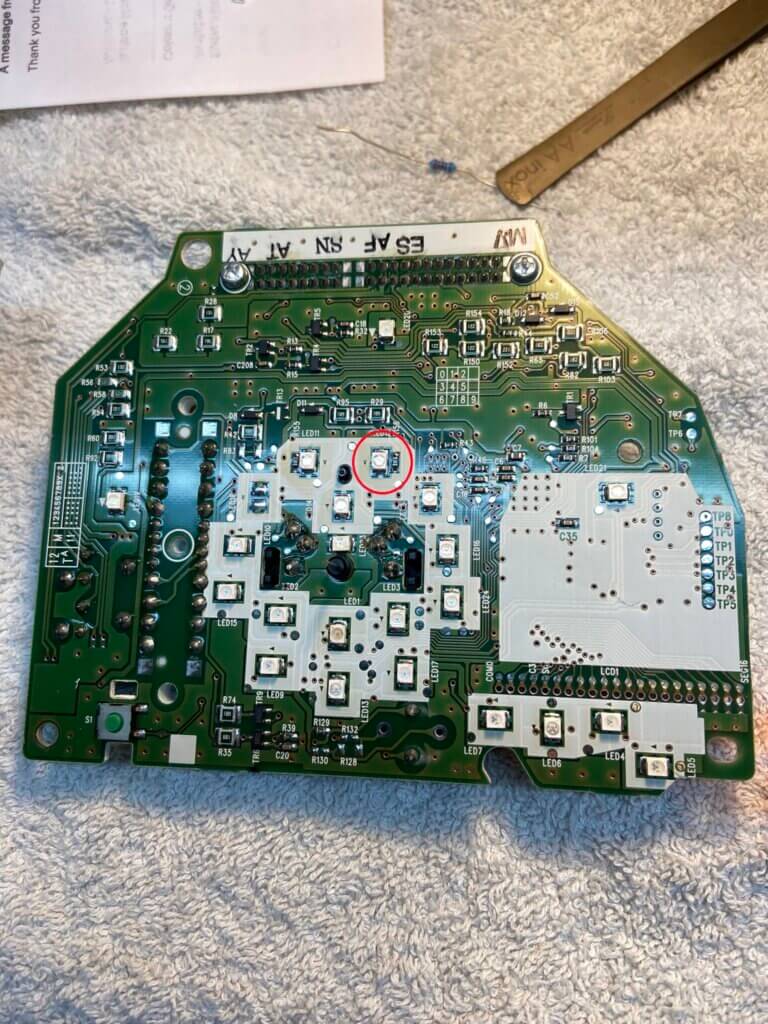
The red circle shows the LED which has failed for the Right Indicator, the LED type is a surface mounted 1210 GREEN colour, (I swopped out the left LED while I was at it).

I bought 10 LEDS from eBay for less than £2, I bought super bright LEDs by mistake, should have got normal brightness, not a big problem but it would have been better on the eyes at night with less bright ones.

Great update from Alistair:

“There are others available from LEDPERF (https://ledperf.co.uk) that have brightness rating of 140mcd …..this is much less distracting! Bit more expensive (0.63p each) ..but really does a good job.”

In preparation for changing them I also bought a 15w soldering iron with a fine pointed tip as these LEDs are tiny.

I already had a de-soldering suction iron from Aliexpress which worked brilliantly to unsolder the dashboard display to get to this point.

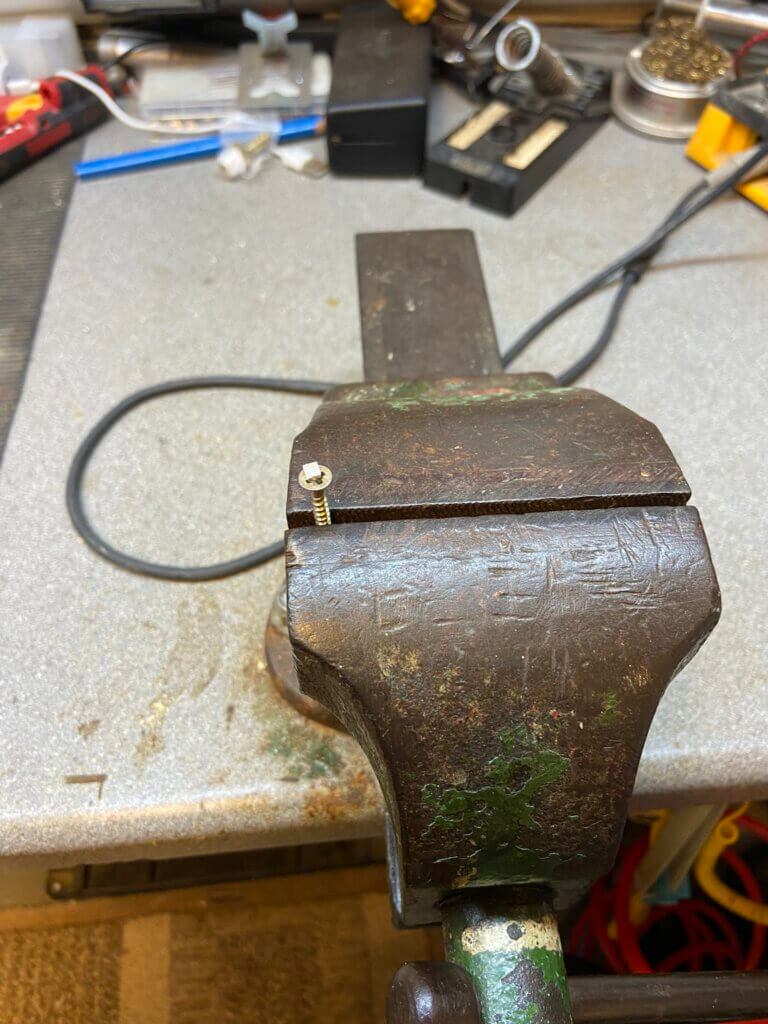
The LED is sat on top of a small screw and I found it a bit of a struggle as I didn’t realize how much my hand shakes, but managed it in the end 🙂
Everything worked fine when I plugged everything back together, BUT I made a mistake when I refitted the speedometer pointer, this meant removing the clear cover and pointer, turning the ignition ON, then pushing the pointer on the spindle at the zero MPH mark, I must have moved the spindle and after putting the pointer on, the servo speed motor couldn’t calibrate as it was hitting the milometer reset button.

This was an easy fix, but still a pain to do after I had though everything was working.

Hope this helps somebody else and thanks again Alistair for sharing your experience.

Convert manual lever valve to automatically close when a water leak is detected

Updated 27 August 2024

I have an irrigation system with a water break-tank containing ~ 400 litres which is used to supply an unattended pump, the problem I needed to solve was what if there is a leak or burst in the pump enclosure, I don’t want the tank to empty.

The break-tank does have a base valve and I saw on Aliexpress that they did 12v clamp on motorised heads which can convert a manual lever valve into an automatic valve, enabling both electrically operated, opening and closing, these cost £10.42 including VAT and postage I thought I’d give one a go and ordered the 3/4″ clamp version.

When the unit arrived, it became obvious that it physically wouldn’t fit on the base valve, so I bought a 22mm full bore lever valve, (Toolstation part 92144), and fitted this upstream of the base valve giving plenty of room for the head to mount.

Fitting of the head is very easy with a clamp being used around the pipe to hold it in place and the moveable arm has adjustable pins for accurate lever alignment.

On the base of the head is a ‘ring pull’, pulling this disengages the motor enabling manual operation of the valve.

The video is a bit rough as this was the first actual test after building the control system and triggering the valve using a licked finger on the sensor.

The motorised head has no positional output, once power is applied, it will drive 90o in one direction and stop, reversing the motors polarity, will cause the motor the drive 90o in the opposite direction and stop, all very simple.

Home Assistant monitors my irrigation system, so it was a logical step to include the leak detection system into that, however, it will run without Home Assistant from the Shelly App.

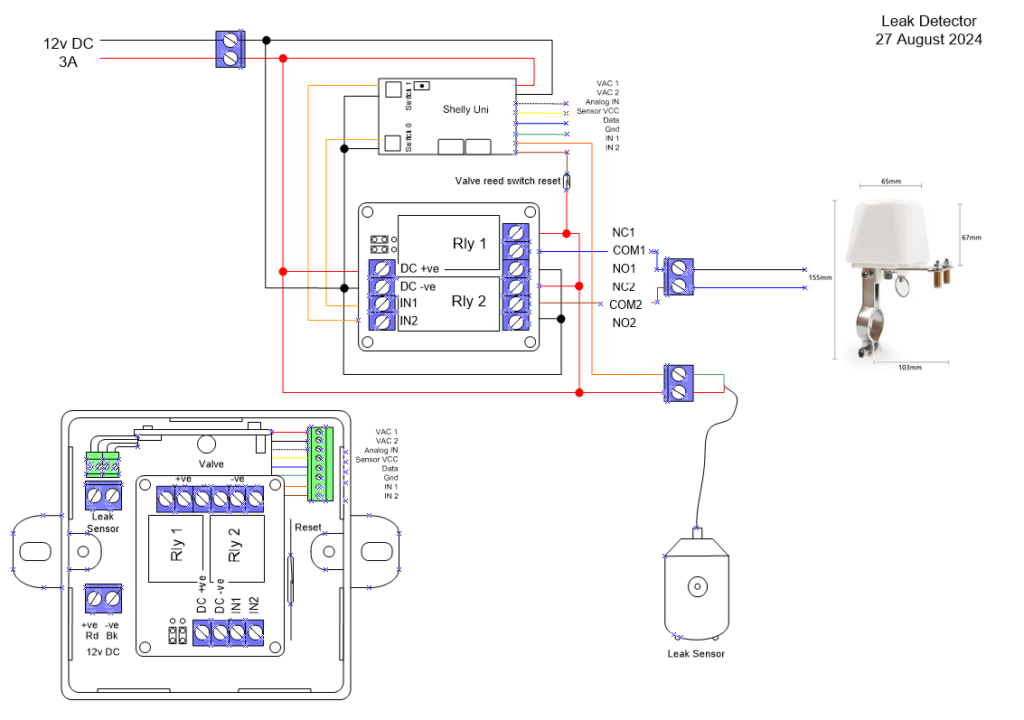
The Shelly Uni has two outputs and two inputs, each of the outputs was used to trigger a relay for valve open and valve close.

One of the inputs was connected to a probe with separated contacts, if the contacts are bridged (wet finger), the Shelly detects this which was perfect, the other input I used with a reed switch so that I could open and reset the valve with a magnet, I chose this way so that I didn’t have to drill the IP rated enclosure, (Toolstation part 91800, 80 x 80 x 50mm), the circuit board will live in.

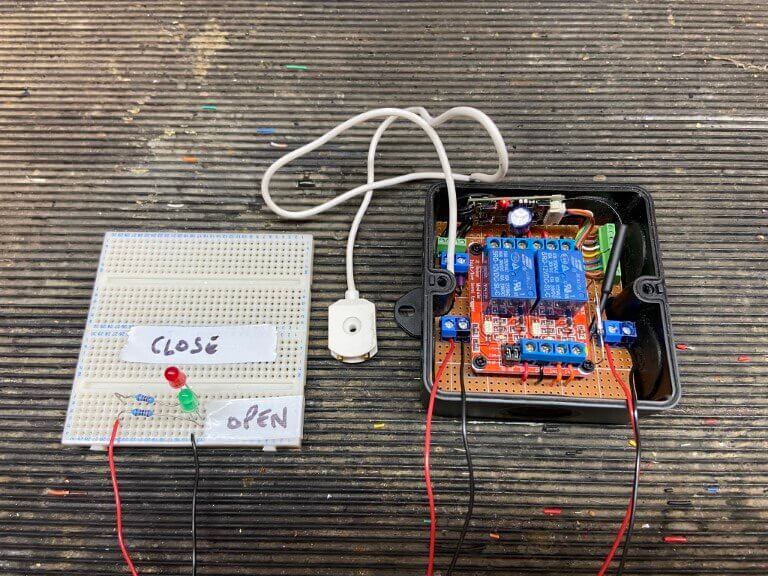
The above image is of the test leds simulating the motor polarity with the finished circuit inside a IP65 rated enclosure.

Finished water leak protection valve wired up to relays within IP rated enclosure.

12v from PSU to Shelly and relays from motor control box, in the top right you can see the white water leak sensor.

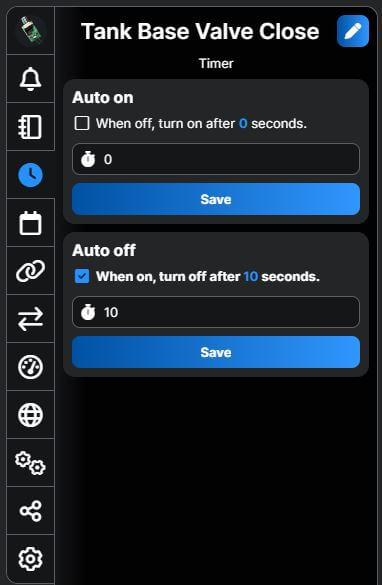
The Shelly Uni has a timed output facility, also the inputs can be linked to the outputs, this means that if the leak sensor detects, the associated output will operate for a preset time, in my case I used 10 seconds for both open and close duration.

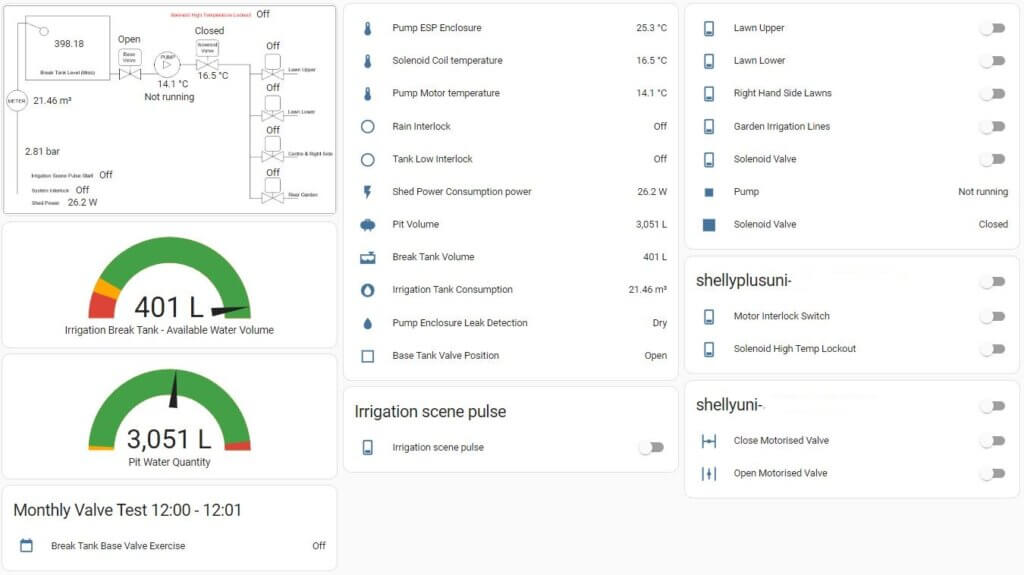
Below is my Home Assistant irrigation status dashboard this shows the status of the leak detection sensor and the valve position, (done by virtual entity toggling status, rather than valve feedback).

When a leak is detected in the pump enclosure, the break-tank base valve will close and at the same time, the pump contactor will be interlocked to prevent operation.

An automation linked to my local calendar, will ‘exercise’ the base valve to close, then open, monthly, this automation will be overridden if the irrigation system is in use or a leak has already been detected.

I can either manually trigger the valve to open by offering a magnet to the side of the control box, or use Home Assistant, once the valve is triggered to open, the interlock comes off the pump contactor.

I have also set up Home Assistant to send a notification to my mobile should a leak be detected not only from the pump enclosure, but from a wireless leak detectors placed by my heating boiler and washing machine.

The mobile alert action below is for the pump enclosure and is triggered when the valve closes on water detection:

Immersion Heater Smart Switch

Octopus Energy have introduced a scheme where they allow you to use electricity at certain periods which they reimburse you for, as hot water heating is our largest daily load, it made sense to fit a smart switch to this as normally the water is heated by the gas boiler, this now means I can suspend the boilers and turn on the heating element.

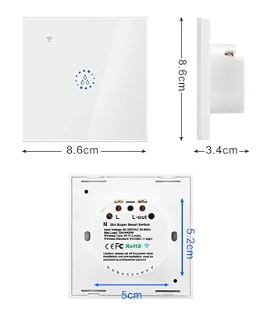
The smart switch is a remote way to turn ON or OFF the Immersion Heaters 3kW element, the smart switch is rated for 20A and by touching the faceplate, manual switching is possible.

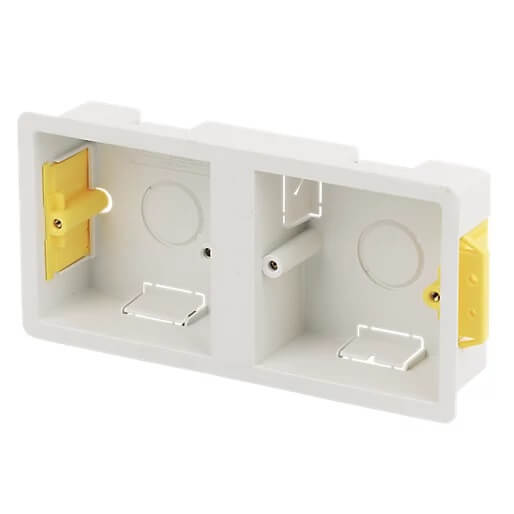
I used a double dry lining box which has a depth of 35mm to accommodate the smart switch, I also incorporated a 20A double pole isolation switch for maintenance.

Wiring was very straightforward, power in and load out, no earth connection is provided on the device, but I used the one on the maintenance switch.

Before installing the unit, I powered it up at the table and connected it my eWeLink mobile App, to do this I ensured the phone was on 2.4GHz WiFi and the device connected perfectly.

The App allows me to set timers to ensure I don’t exceed the allocated free electricity periods, I’ve also set up notifications when the switch operates as a confidence check, its early days, (13 Nov 23), but I’m hopefully this will last.

The details are:

Smart Switch for Electric Boiler, FORNORM 20A 4400W Water Heater Switch Timer Controlled by Amazon Alexa/Google Home, APP Remote Control “eWeLink”, 2.4Ghz/Neutral Wire, White

Bought from Amazon for £23.99 – LINK

WindowBridge Ladder Support Across Window Openings

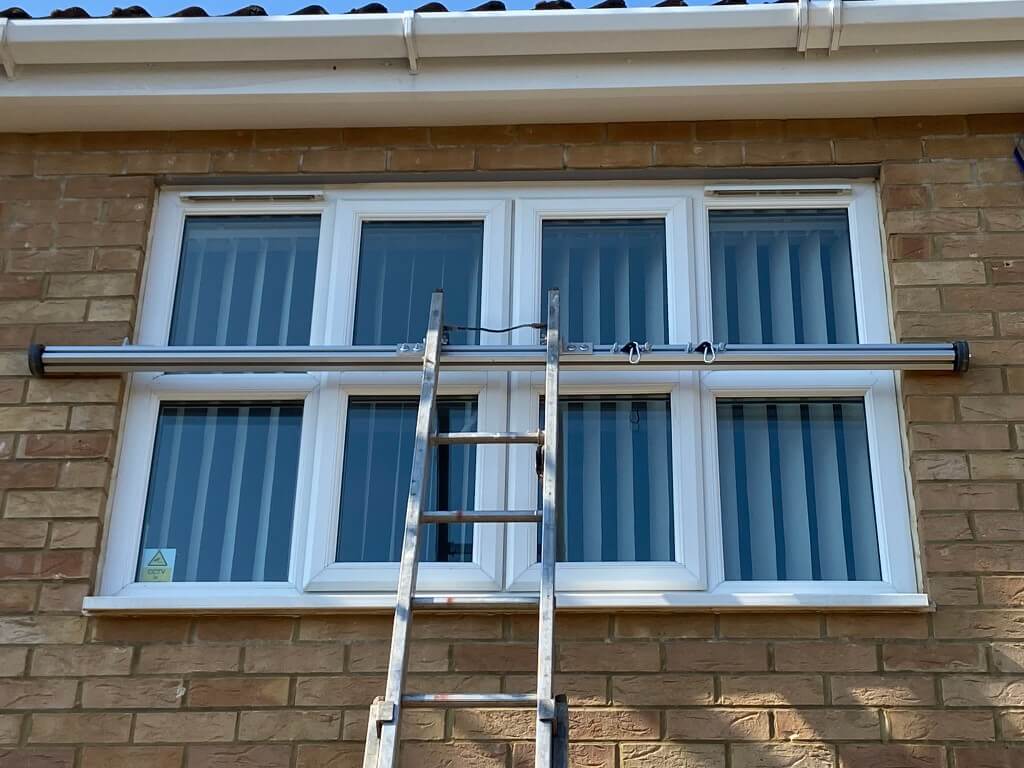
Homemade WindowBridge across a1900mm window reveal in action, securely fixed to the ladder and with a couple of convenient sliding ‘snap hooks’.

Problem to solve

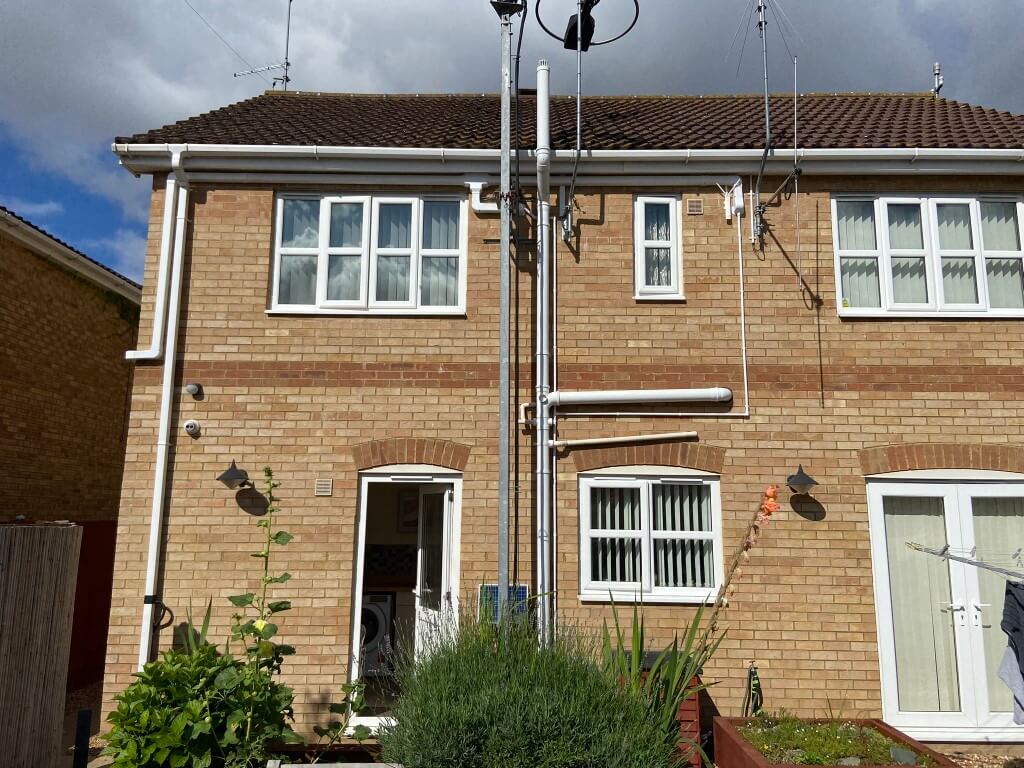
Cleaning the gutters and upstairs windows has always been tricky with ladders, as I had to try and get the top of the ladder wedged between the top two courses of bricks and underside of the soffit, the problem was compounded when I had Air Conditioning installed and the pipework trunking used this area over a bedroom window.

At the front of the house, the top half is painted render, so I had wo wrap the ladder with a towel when cleaning the upper window so I didn’t damage the wall paint, the WindowBridge sets out to solve this problem, safely.

Looking online, the only alternative was a ladder standoff clip on bracket which I already have but don’t feel 100% safe using, I did message a company who made a product called Windowspan, but received a weird email reply and checking with Companies House, the company is registered as dormant.

This left no option but to make my own, which I’m calling the WindowBridge.

Build

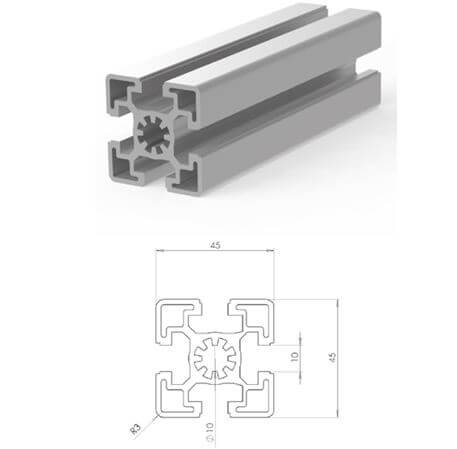
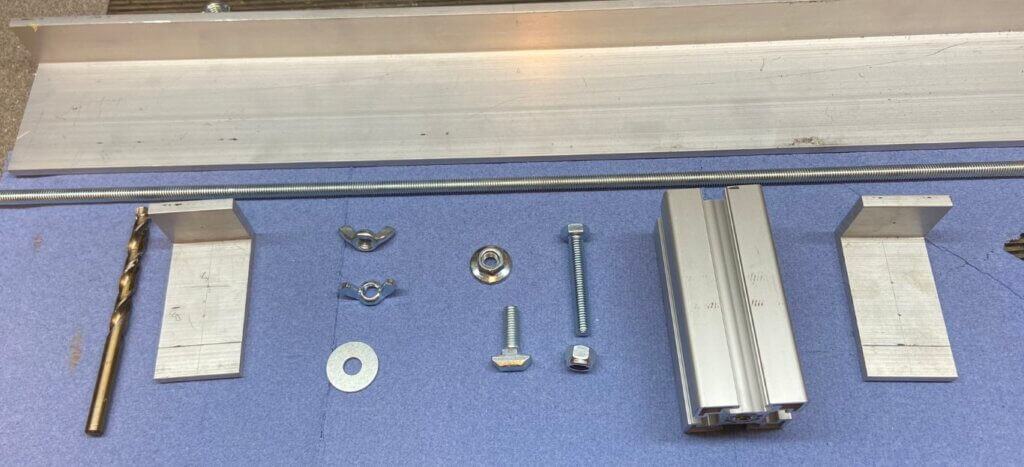
This is a very easy project to build with parts readily available online, the finished WindowBridge weighs in at 4.8kg, I opted for a heavy duty 45mm x 45mm aluminum slotted profile as this was the first one I had built, I wanted to avoid any sag in the span when the ladder was loaded.

A 4 channel profiling for chosen for use with M8 T-bolts to give me total flexibility of any attachment fixings in the future although other profile options are available.

The finished length of profile used is based on the maximum opening that I needed to bridge, in my case it was 1900mm, therefore, the length of the profile in my project was 2100mm giving a 100mm overhang at each side, with the addition of the wheels, the overall length is 2160mm.

I bought 2200mm of profile and cut a 100mm test piece from this using a Screwfix cross cut circular saw, this saw was also used for cutting the brackets giving a neat cut, details of the blade are in the materials list.

Wheels

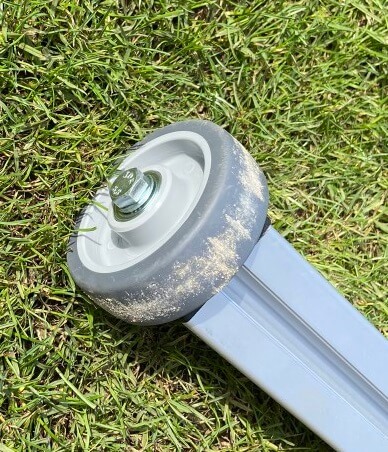
75mm diameter, ball bearing, rubber wheels were attached to the profile by M8 high tensile steel bolts, the bolts fastened into nylon locking nuts embedded in the profile.

I opted for rubber wheels to give a level of sideways slip resistance and also they are kinder to a painted rendered surface which I have at the front of the house.

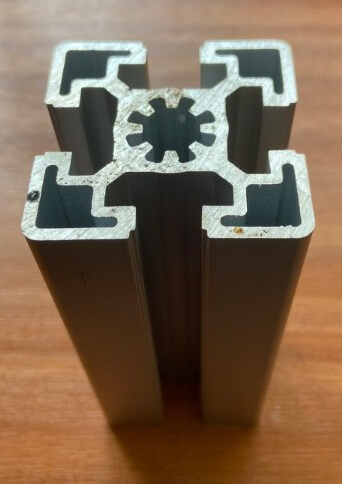
Test off-cut of profile showing the center casting, using a 12mm cobalt drill, I drilled into the center just deep enough to accept the M8 nylon locking nut so its flush with the face of the profile, make sure you clamp the profile securely as it will ‘snatch’ when drilling.

The nut is an ‘interference’ fit in the drilled hole, so the use of a hammer is needed at this stage of the build.

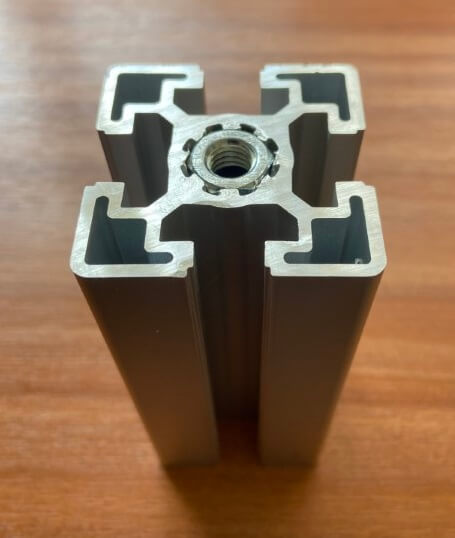
Test piece with the nut installed, this is a really solid fixing, the completed wheel assembly is shown below:

Ladder Attachment

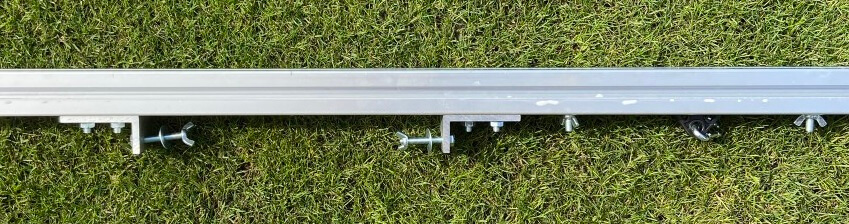
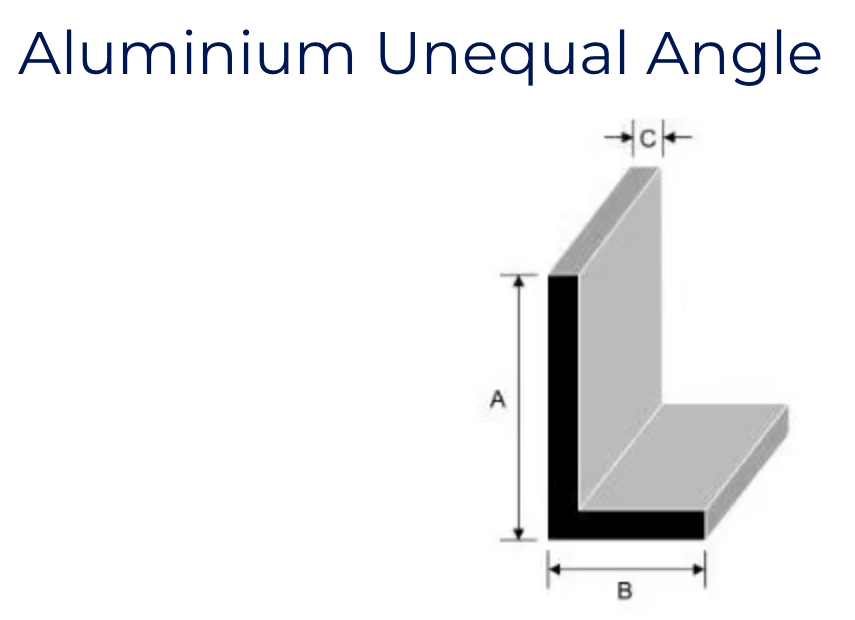
I used two pieces of aluminum unequal angle brackets to secure the WindowBridge to the ladder, one bracket for each side of the ladders external side rail, the brackets were attached to the profile by two M8 ‘T-Bolts’.

I drilled a 8mm hole in the center of the smaller part of the bracket and with the ladder in-situ, drilled though the ladder side rail to accept the M8 x 50mm bolt which uses wing nuts for ease of assembly.

Another method would be to pass a length of M8 treaded bar through the ladders hollow rung and brackets to avoid drilling the ladder, for me it didn’t matter, but its worth consideration.

The aluminum I used for the brackets was not ordered, but picked up on the day from the factory in Leicester, so I don’t have any details other than dimensions:

  • A – 75mm (3″)
  • B – 40mm ( 11/2″)
  • C – 5mm (1/4″)

Materials

Conclusion

I should have made one of these years ago, no more precariously positioning the top of the ladder or over-reaching when cleaning the windows.

The most expensive item was the aluminium profile, the rest of the items were relatively inexpensive.

Cutting aluminium needs the right drills and blades to give a decent finish, I have included in my parts list tools I purchased to help me.

I could have made the WindowBridge slightly shorter in length to reduce weight marginally whilst still allowing a reasonable span across the window reveal, but overall I’m really happy with it and it is manageable to use.

Qualcast Classic 35s Replacement Throttle Cable

Updated 7 July 2023

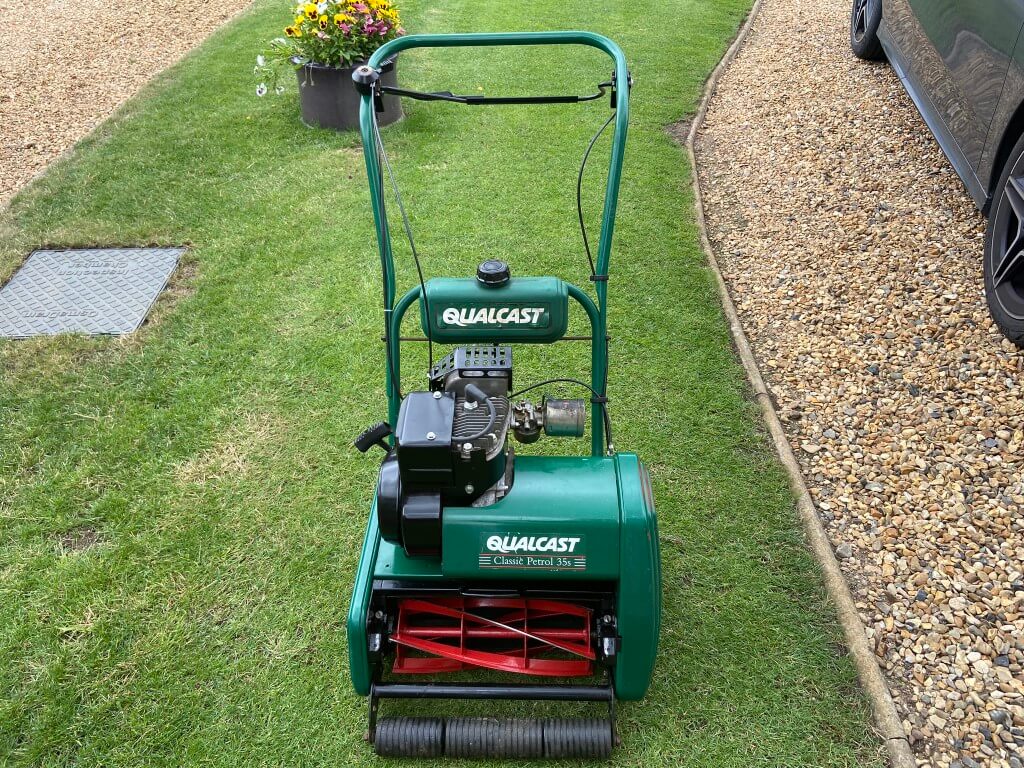
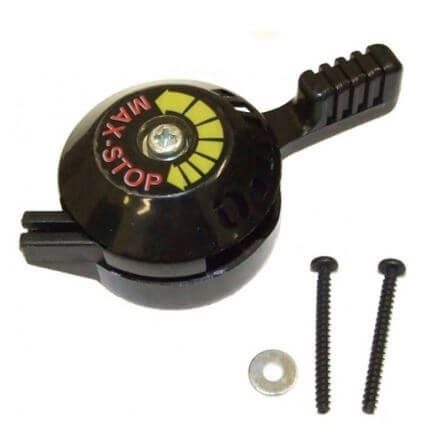
I bought a previously used Qualcast Classic 35s in 2021 for £40 complete with Scarifier Cartridge as a project and after replacing serviceable items and sharpening the blade, the mower performs really well, the problem was getting hold of a replacement throttle cable for my 1999, Type F016C80961 mower.

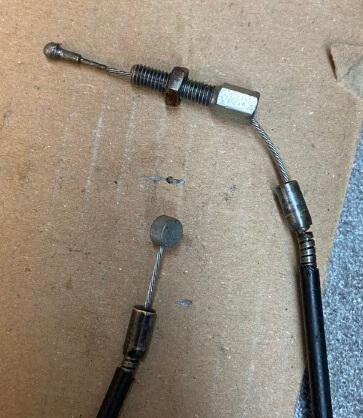
The outer cable is damaged at each end and the inner cable is ‘notchy’ due to kinks, so I set about trying to find a replacement and constantly drew a blank.

I did buy a new cable off eBay on the off chance it would fit my make of Qualcast mower, but the outer was too long and although it had the correct ends, the lengths of the inner cables weren’t long enough to work.

After watching YouTube for ideas, I decided to make a new throttle cable.

How to make new cable

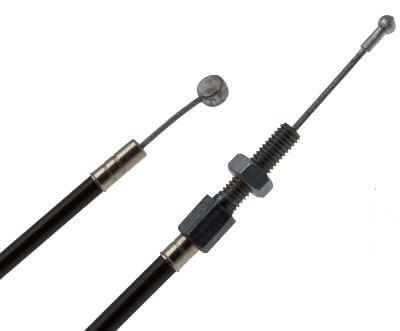
The cable I’m going to modify was described on eBay as ‘Throttle cable fits some Qualcast Suffolk Colt and Punch Mowers’, the cable cost £6.58 and was 910mm in length.

Using a Dremel with the cutting disk I reduced the 910mm cable by 230mm to 680mm after first removing the inner cable.

I did buy some 4mm plastic cable ends for the freshly shortened cable, but they were to wide to fit inside the throttle levers recess, so I prised off the chrome cable ferrule from the off-cut and used the shank of a 4mm drill bit as a former to get it back in shape as it was misshaped after prising and made do with that on the new cable, (you can easily get 5mm metal ferrules, but 4mm ones are really hard to get hold off for some reason).

Now the outer is cut to length, I threaded the cable back in the inner, not forgetting the adjuster for the carburetor end, the inner cable was then pulled all the way until it stops, the inner was then marked 60mm from the end of the ferrule.

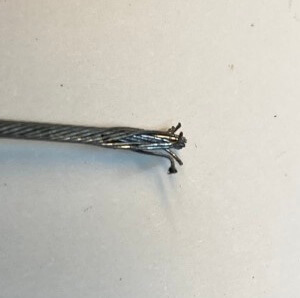
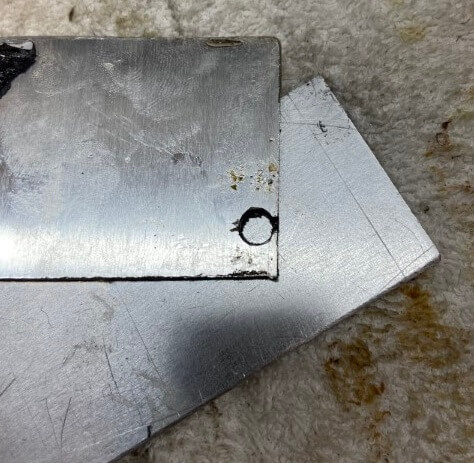
Again the Dremel was used to cut the inner cable and the individual wires were ‘splayed’ slightly to allow greater surface area when the lead is added to the mold.

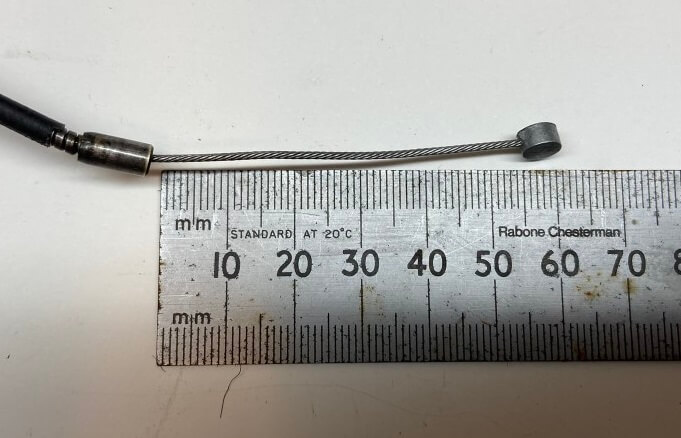
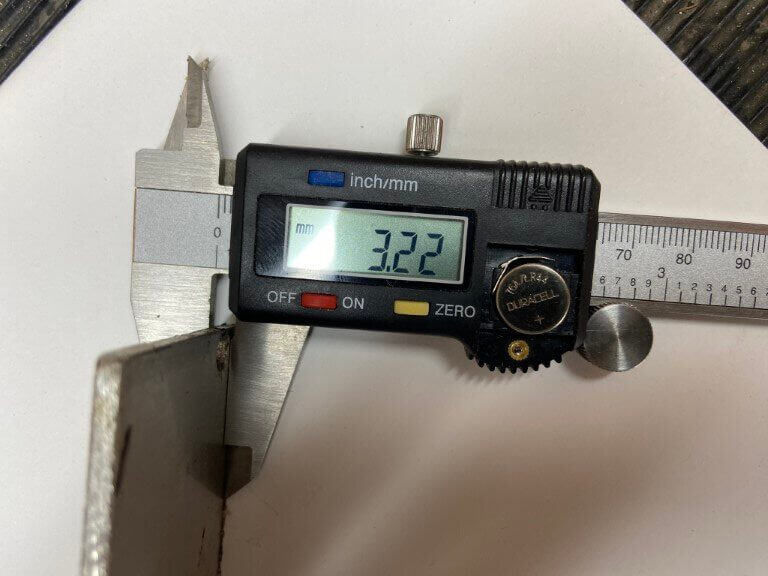
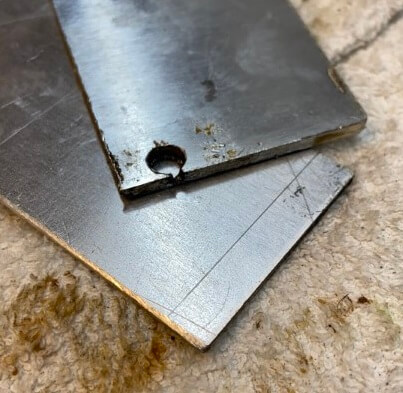
Next step was to make a casting mold for the throttle lever, the cable nipple has a diameter of 6mm and a thickness of 3.6mm, in my scrap box I luckily had an off-cut of aluminium which happened to be 3.22mm thick which was fine as its the diameter which is important rather than the thickness of the nipple.

A 6mm drill for the hole ensuring that it was deburred reducing the chance of the lead sticking to the mold.

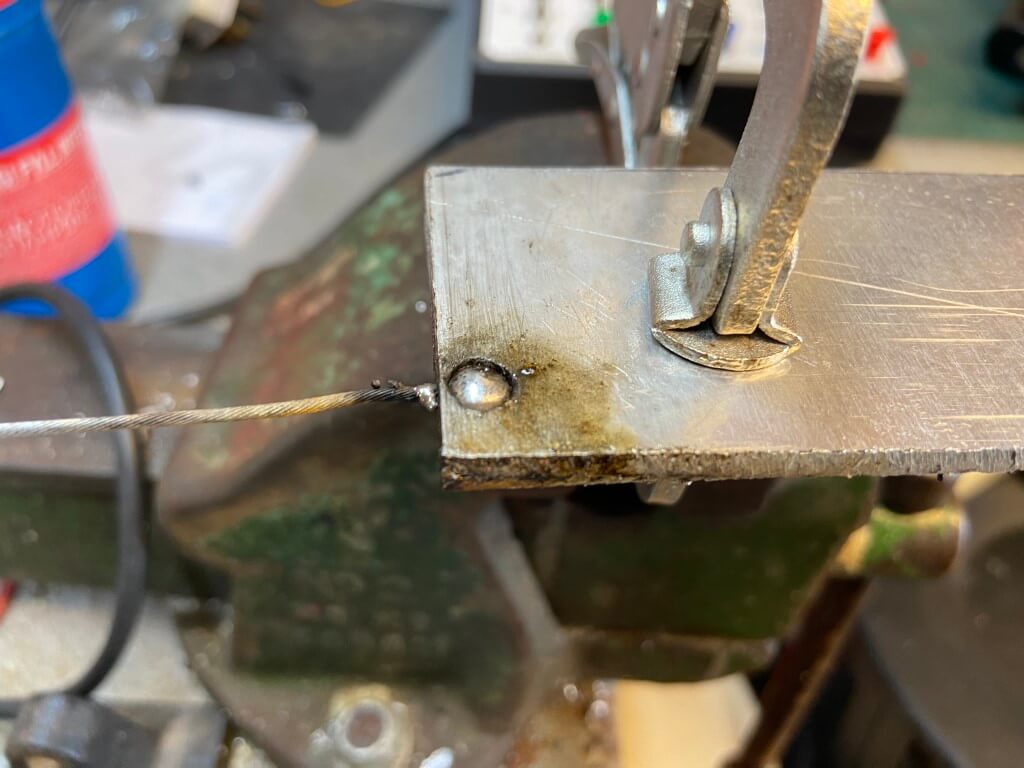
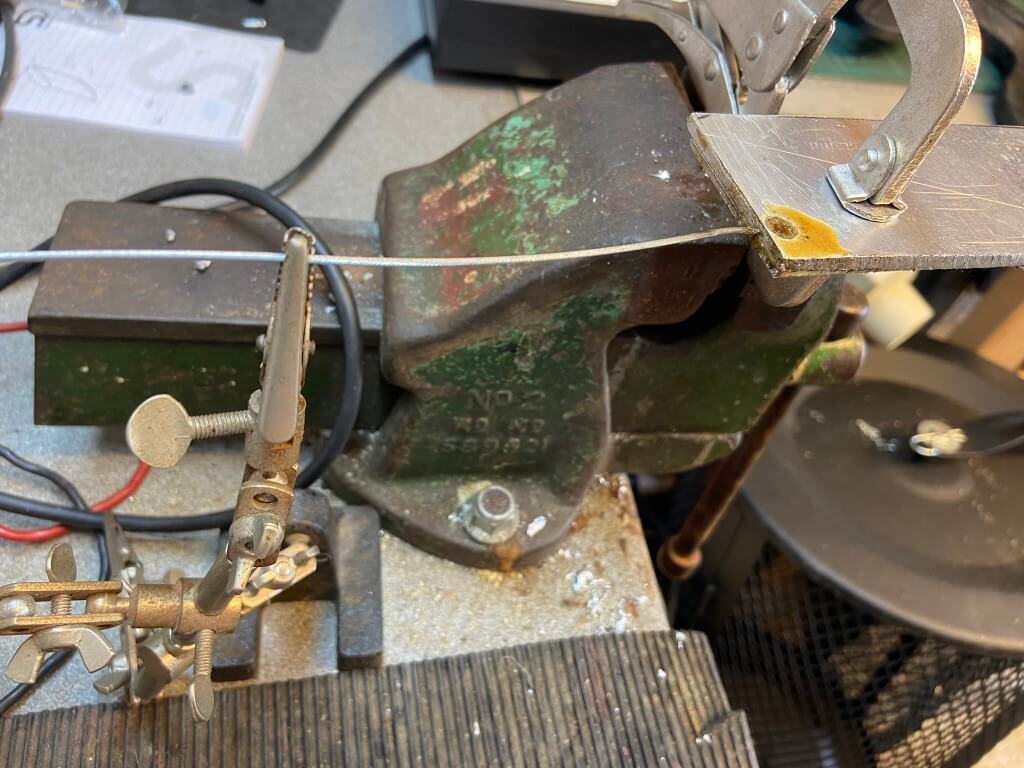
Using a Junior Hacksaw I made a cut wide enough for the cable and half way through the aluminium, this is where the splayed cable will sit for the casting process.

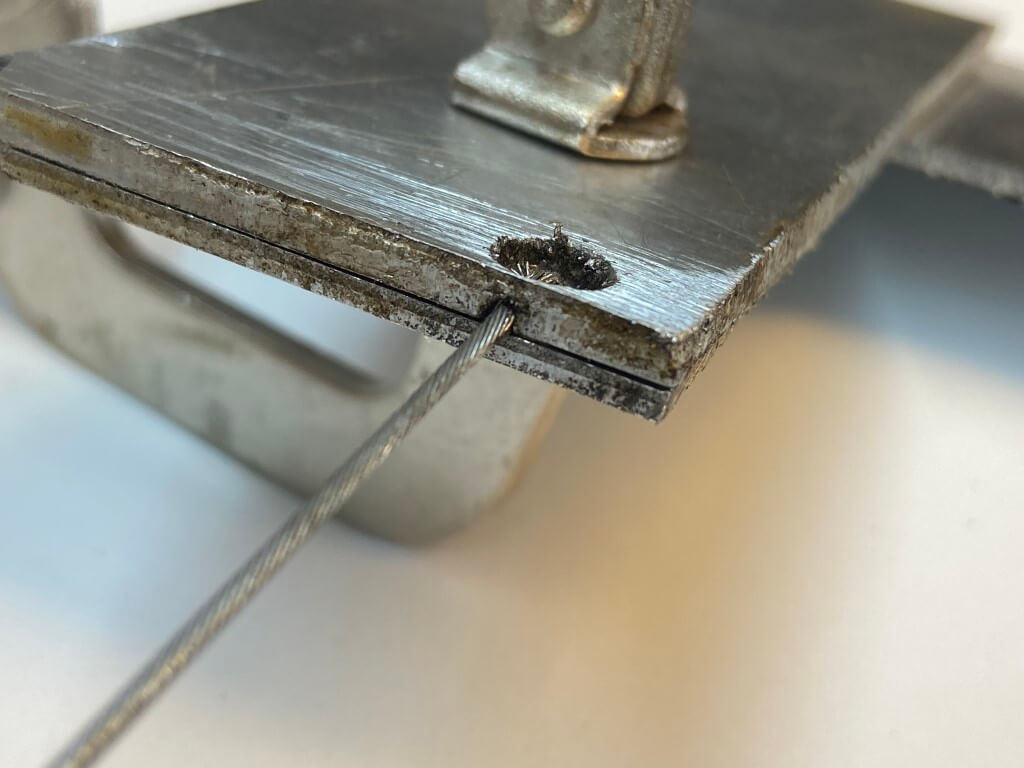
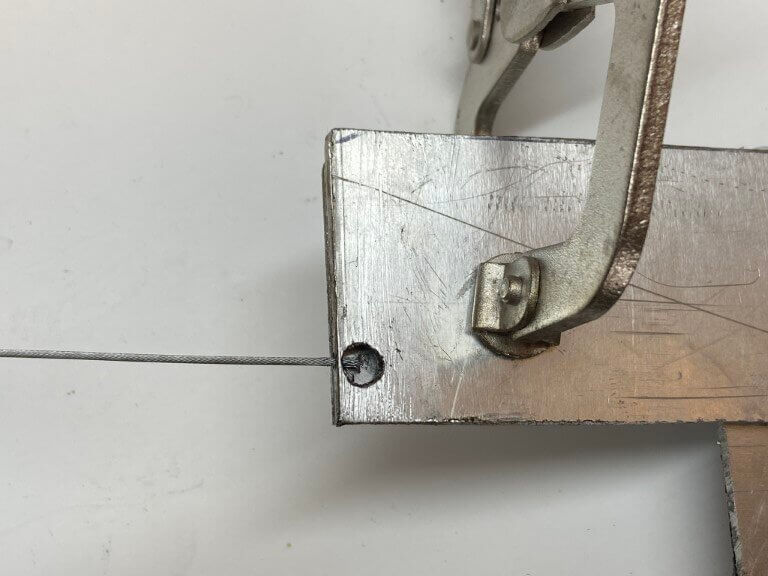
The cable is put in the mold and the two pieces of aluminium are then clamped together with mole grips.

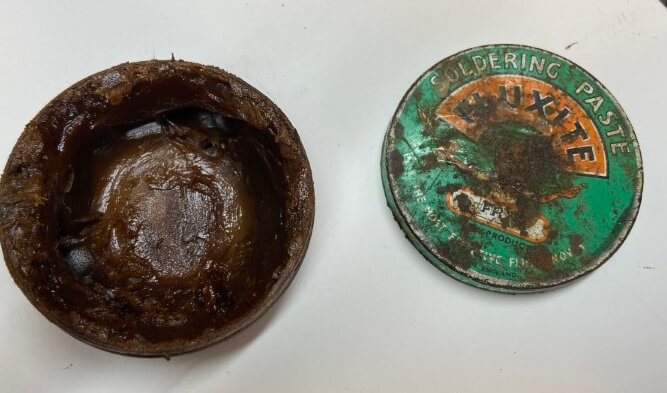
With the cable degreased with ‘White Spirits’, the jig was fixed to the vice and the mold then fully filled with flux, (soldering paste).

To support the cable in the right position and to keep it level, I used an articulating bench helping hand tool.

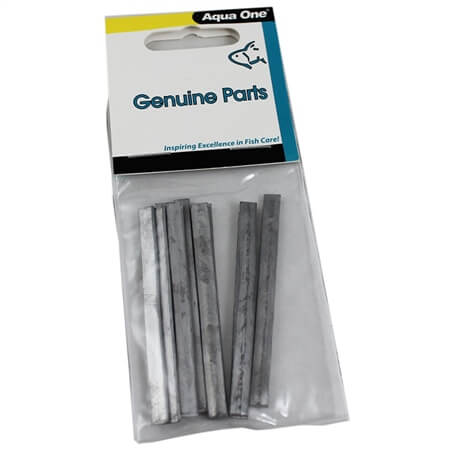
The casting lead used was for holding plants down in an aquarium and readily available online from £3.99 per pack.

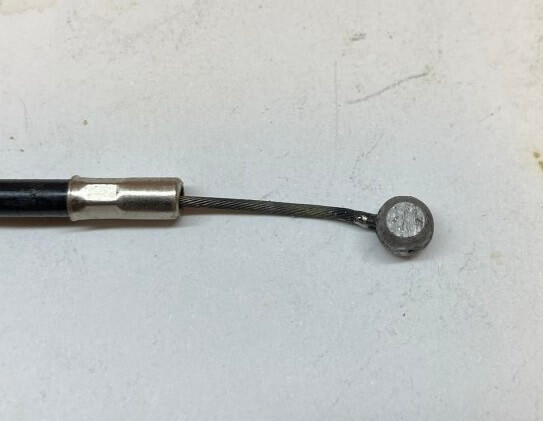
Using a gentle heat to the mold, I melted the lead stick, (not solder), into the mold and let it set when full.

After natural cooling, I unclamping the aluminium sheets which formed the mold and the cable nipple came away easily, and I’m very happy with how it turned out.

Installing the new cable in the mower, everything works as expected and if you are stuck for a replacement, give me a shout and I’ll help if I can.

Manuals

I’ve added some information on my model of Qualcast mower which you might find of use, I’ve scanned some so apologies for any handwritten notes on them.

Flowzone Sprayer Battery Repair

Rechargeable 18V/2.6Ah Li-Ion battery

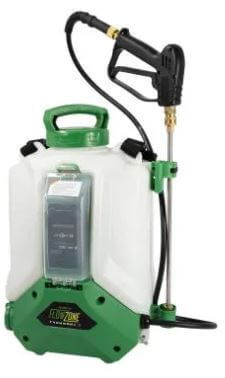
I bought a Flowzone Cyclone 2.5 battery pack sprayer and I love it, however I did experience a battery issue and the company were superb in sending out a replacement.

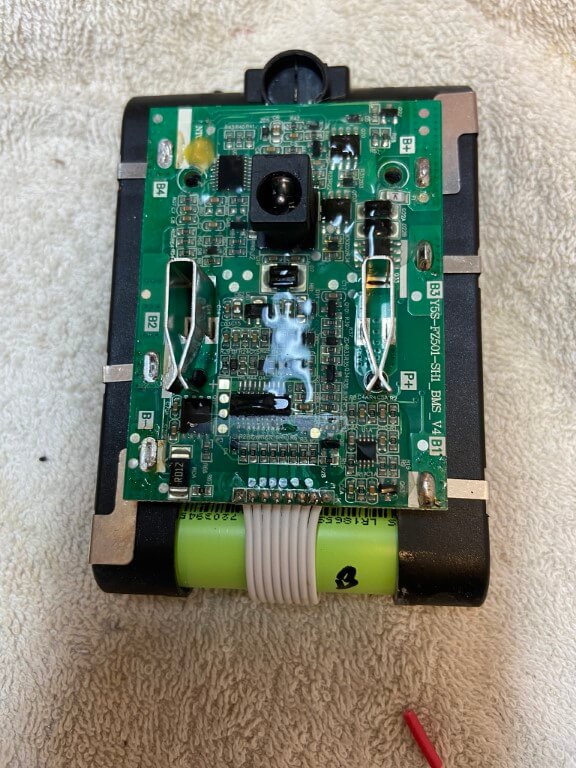
The issue I experienced was that the battery power level only indicated a red flashing LED after being on charge overnight, the battery test is operated by pressing the orange battery symbol and all green LEDs should illuminate after changing.

I did offer to send the faulty battery back to the supplier but they were happy for me to dispose of it, so I thought I’d open it up to see what’s inside.

A T10 x 50mm Torx security screwdriver was perfect to remove the four securing screws, the screws aren’t security ones, but it was the only one I had in the right size.

A cool feature of the battery is that the low voltage charging transformer lead plugs directly into the rear of the battery, no external charger is needed.

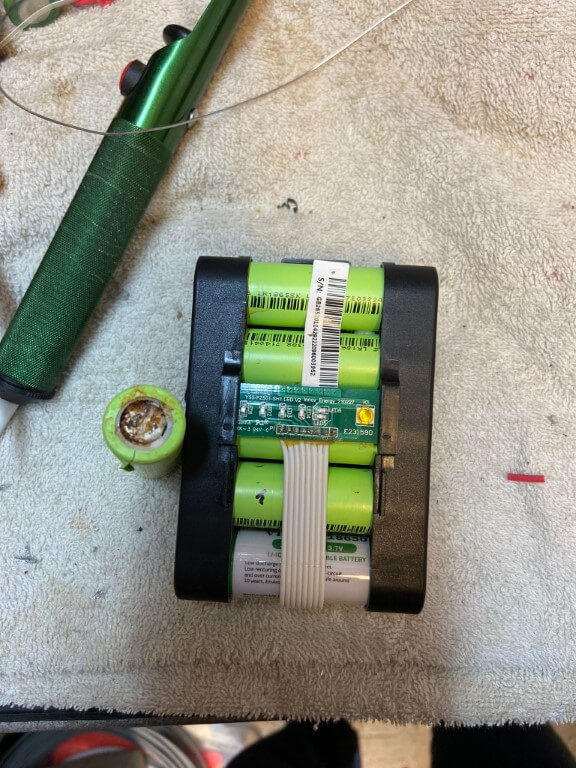
The battery pack contains 5 li-ion rechargeable 3.7v type 18650 batteries, once charged the voltage per battery is 4v, testing each battery in turn, it soon became obvious which one had failed as its voltage was 0.37v and the end cap showed signs of discolouration, not sure what caused this, maybe the battery compartment door wasn’t double clicked closed and water got in, I don’t know, but I’m very careful to make sure everything is dry by the battery just in case.

Above picture shows removed dead battery and the new one in-situ, battery cell replacement was quite difficult as the cell connections were spot welded on, and cells were interconnected, fortunately it was the end cell that needed changing so I peeled off the spot welded tab and unsoldered the tab connections on the PCB and this gave me enough room to get the old one out and the new one in.

Once the new battery was in I used some liquid flux, tinned the tabs and cell connections to make the heat contact on the battery as quick as possible using my Weller 100w soldering gun.

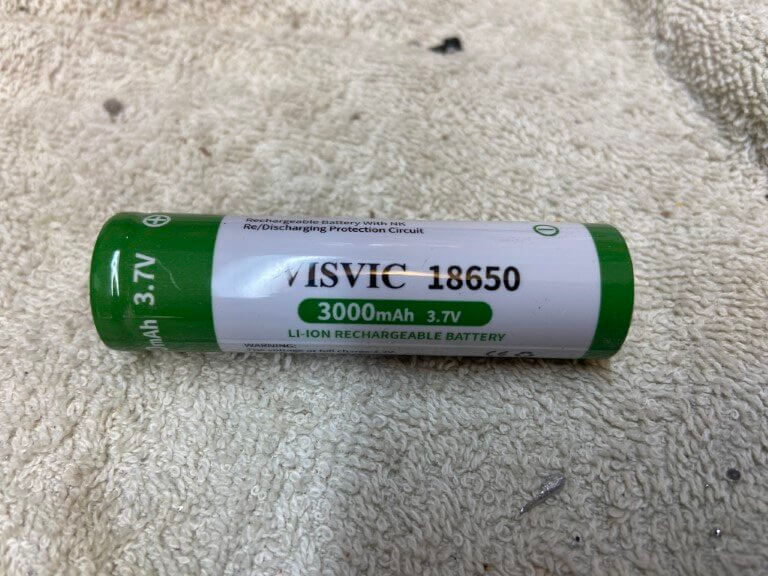
Everything works which is a result, also I have 5 battery’s left over as I had to buy 3 lots of 2, pity they don’t sell them individually they cost £20.62 but I do now have a spare, so can’t complain 🙂
Making a Lawn Lute

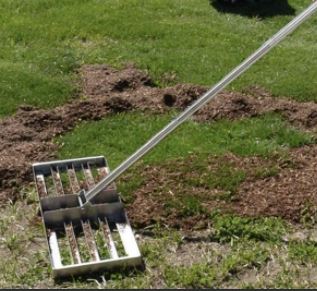
Lawn Lute

I’ve not done anything to my front lawns, other than mow the grass. This year (2022), I thought I would invest some time in trying to get them looking better without the weeds and moss, by the way, I’m certainly no lawn expert!

After treating the lawn with a moss and weed solution and after scarifying and aerating, I needed to level out the surface of the lawn by using a Top Dressing comprising of a sand and soil mix in a 70:30 ratio.

Their are a number of tools which can be used to spread and level the lawn, these are a Drag Mat (or variant), and a Lawn Lute.

Manufactured Lawn Lute, the one pictured is made from Stainless Steel and costs £130

The cost of a manufactured Lawn Lute can be well over £100, so I decided to make my own.

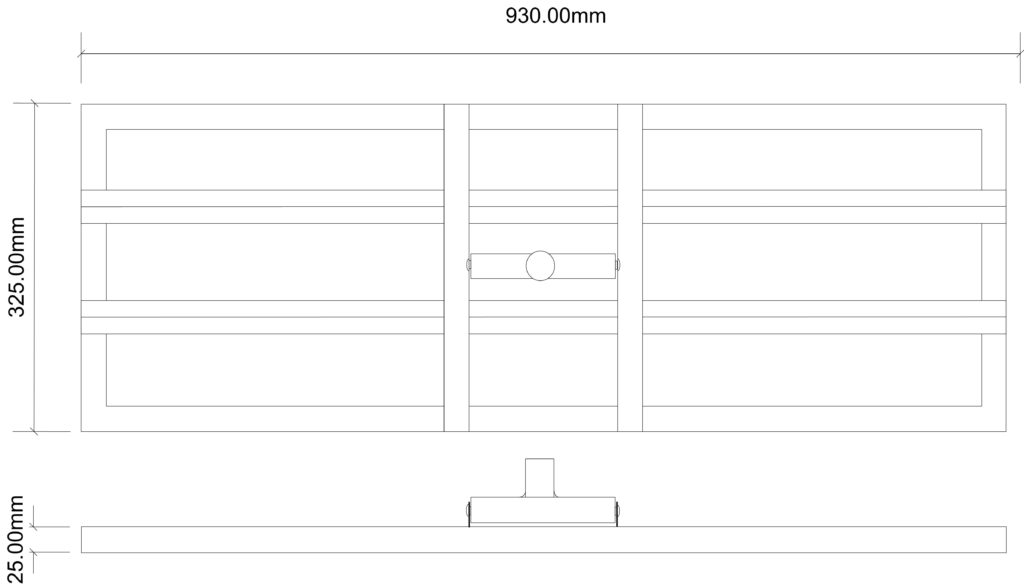
Dimensioned cutting plan of my lawn lute.

The tools needed were:

  • Welder
  • 3.2mm 6013 Welding Rods
  • Angle Grinder – Metal Cutting Disc
  • Tape Measure
  • 5.3m of 25mm x 25mm x 3mm Mild Steel Angle Iron
  • 2.2m 25mm Galvanized Conduit
  • 25mm Galvanized Threaded Coupling
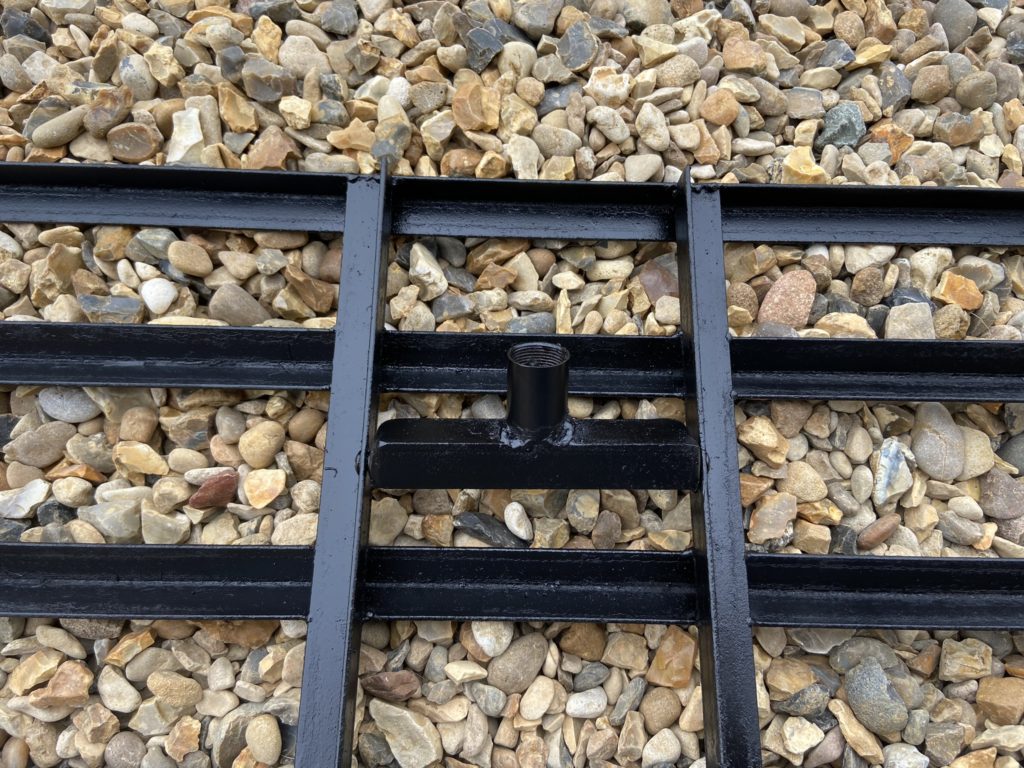
Hinge assembly

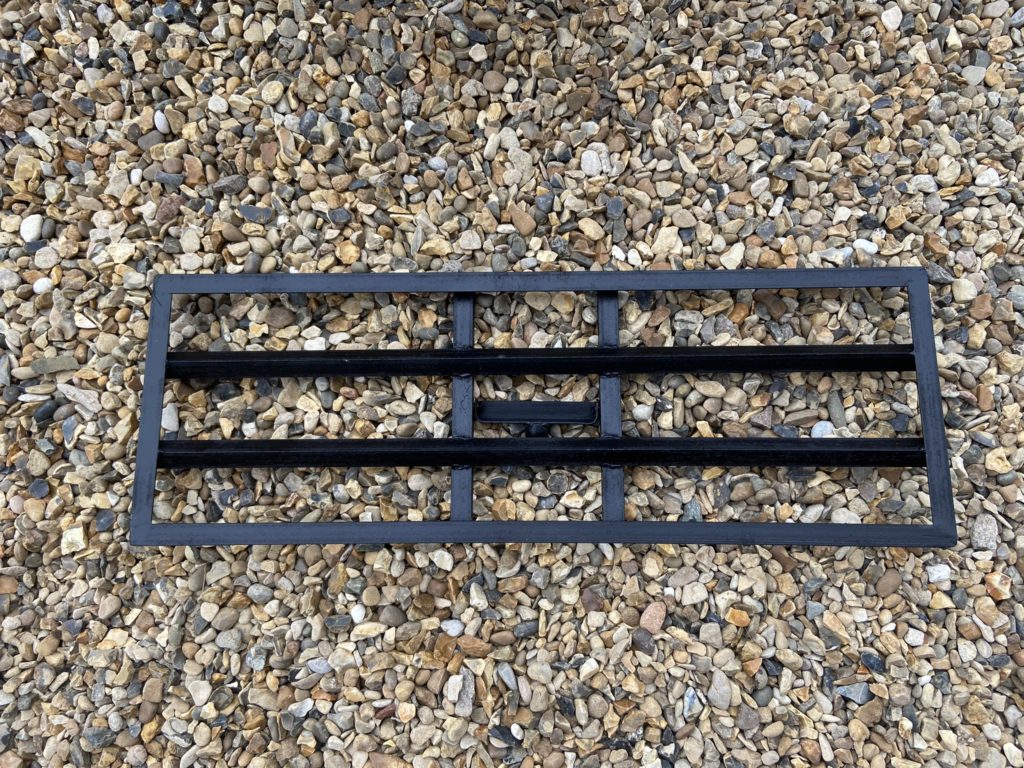
The construction was fairly straightforward, once the angle iron was cut to length, the outer frame was welded and then the internal cross pieces were added.

The cross pieces are welded so that the ‘V’ is on the inside, meaning the ‘sharp’ edge is in contact with the ground when in use.

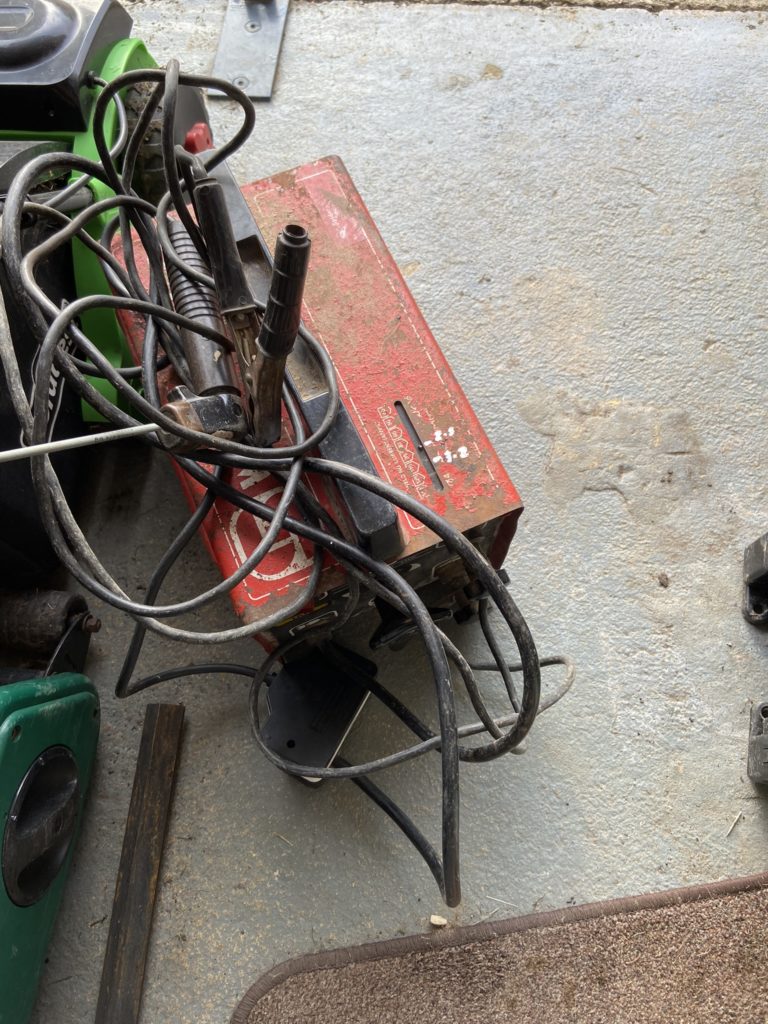
‘Old Faithful’ – Weldmate 140 Stick Welder.

The hinge was made by using a small length of angle iron with the ends cut to allow a flap to be formed, this was then bent over and welded, 6.5mm hole was drilled in each end to the hinge and this was then lined up the two other lengths of angle iron which sit on-top of the cross pieces.

Once all ‘square’ everything was welded into place, the last step was to weld a 25mm coupling onto the hinge, as these are galvanized I needed to grind off this coating due to the fumes when welding.

The handle is a 2.2m length of 25mm galvanized electrical conduit which screws into the coupling when needed, but unscrews for easy storage.

The cost of construction was £44

  • Welding rods (I did buy a big box for other projects) – £22
  • Angle Iron – £12
  • Cutting discs – £10
  • Coupling and conduit already had

If you do zoom in, please don’t crucify me for my poor welding 🙂

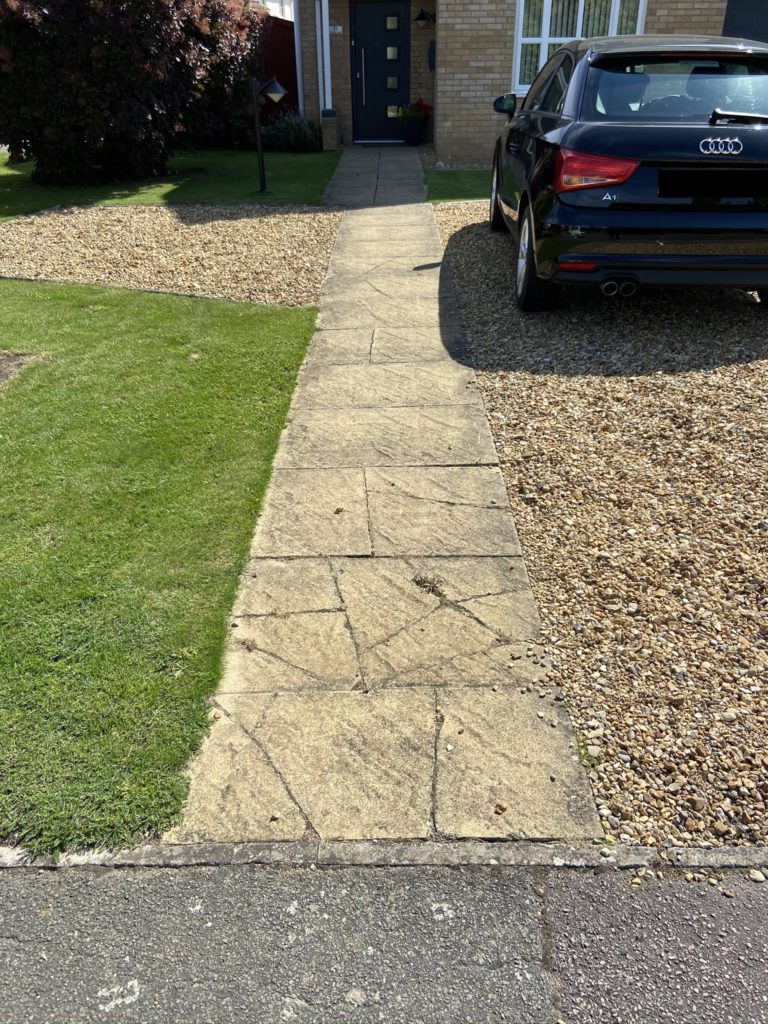
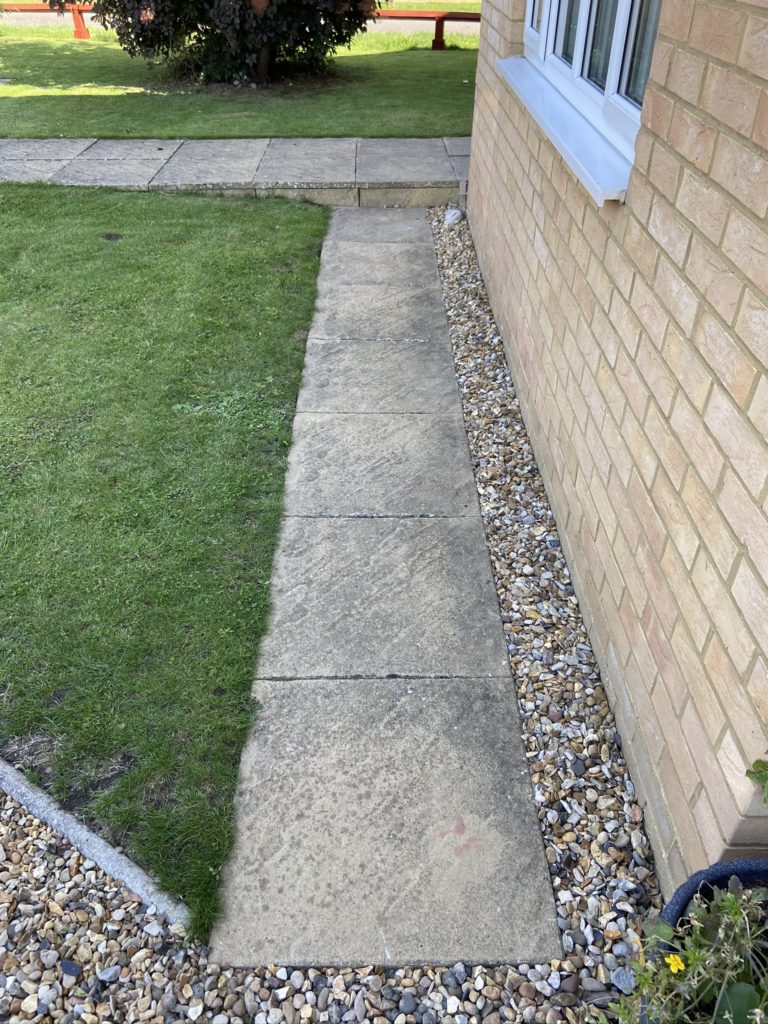
Block Paving Path

I laid my first block paving path over 20 years ago at a different property, so I knew the basics when we needed to give my existing path a makeover.

Broken flags due to delivery lorries delivering materials.

We knew it was going to be paving blocks, but the colour and pattern needed to be worked through. We did know that only pedestrian traffic would use the path, so the block thickness only needed to be 50mm.

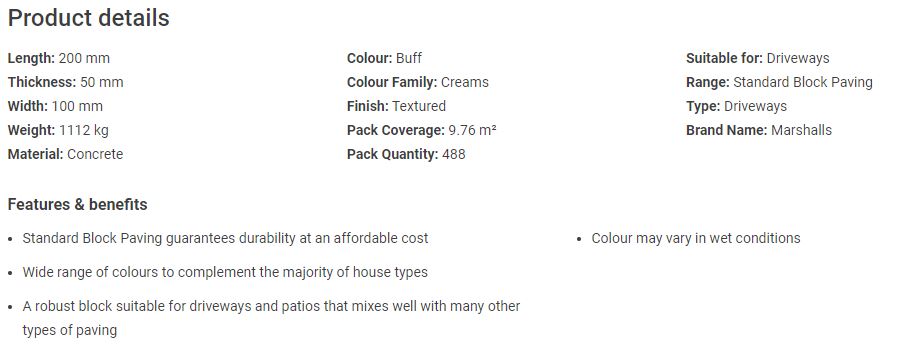
Looking online. the colour of block which is in sympathy with the house brick is Buff, Wickes turned out to be the most competitive at the time of purchase.

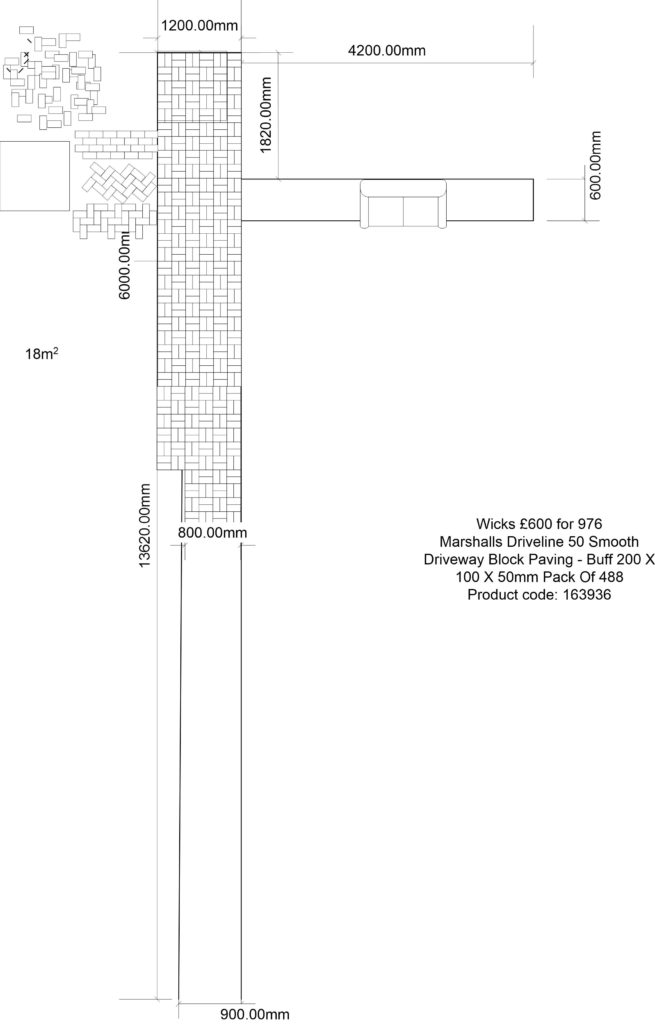
Block Setout Plan

Drawing a plan, gave the overall number of blocks required and we went for a very simply laying pattern to reduce block wastage to an absolute minimum after comparing laying options, (my previous attempt used a ‘Heringbone’ pattern which looks really nice but is very cut intensive and generates a lot of waste).

Materials

After ordering the pave block, I needed the following:

  • Concrete edgings
  • Metal edgings
  • MOT1 hardcore
  • Sharp sand
  • Kiln Dried sand
  • Skip

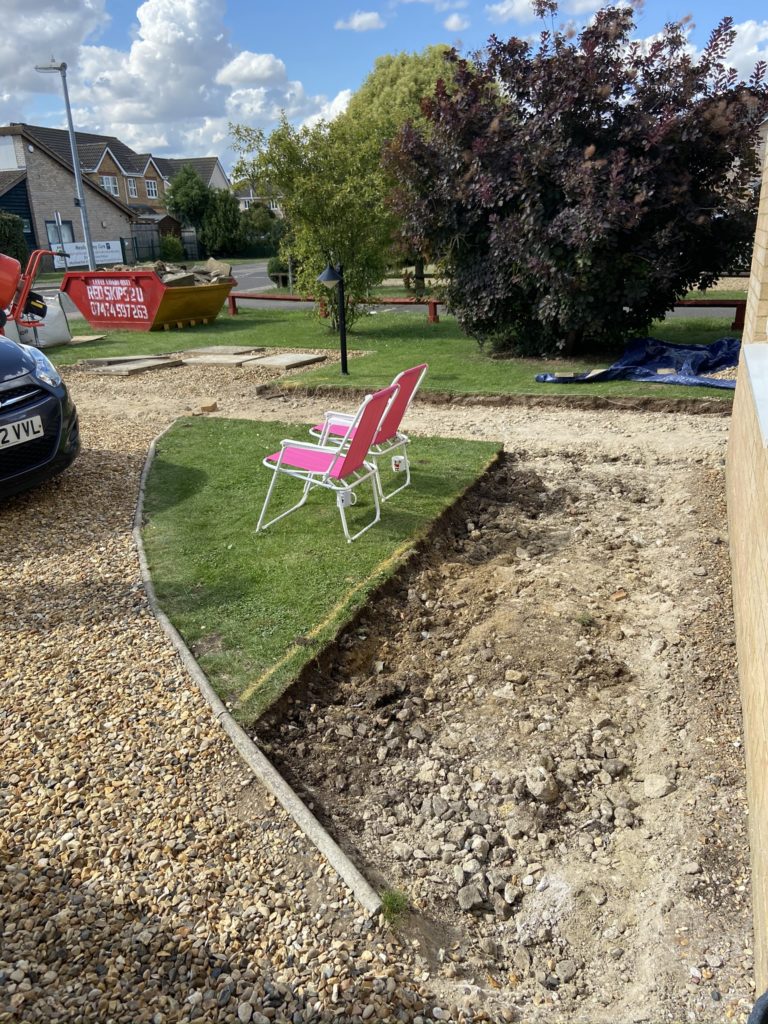
It was time to get the shovel out and get rid of the old path!

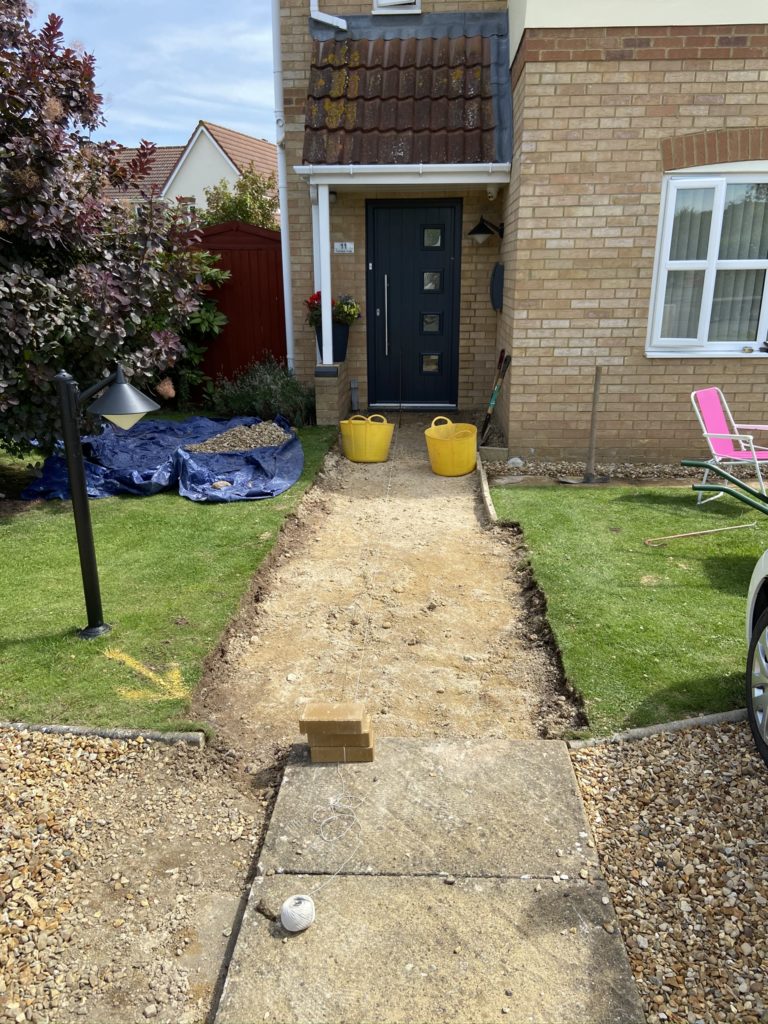
Yellow arrow indicate lighting cable duct.
We decided to widen the path to allow for a bench as this is a sun trap in the afternoon.

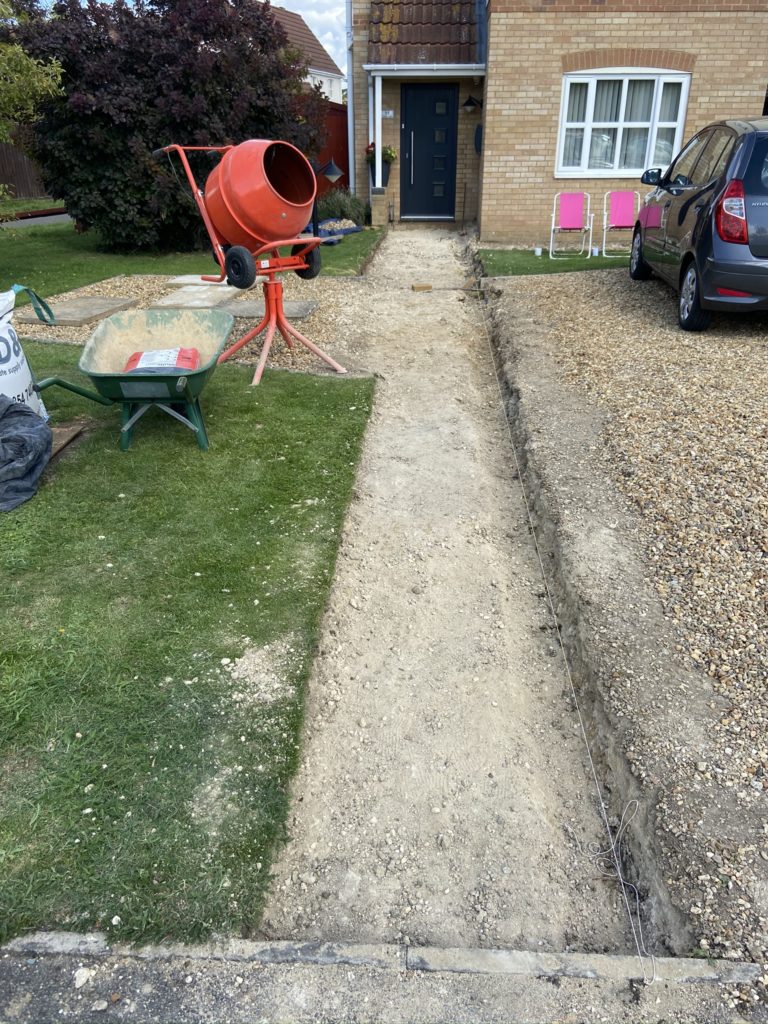
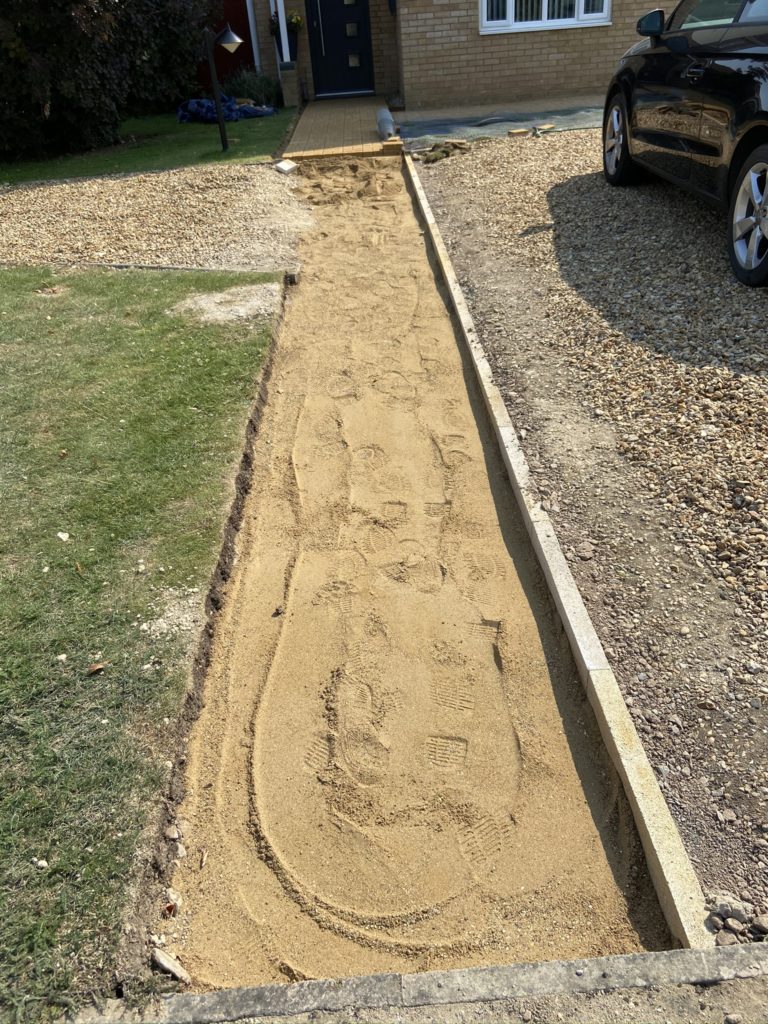
Once all the path was dug up, it was time to run a string line out for my straight edge, the width of the path isn’t that critical at this point, as I can take space from the lawn to add width.

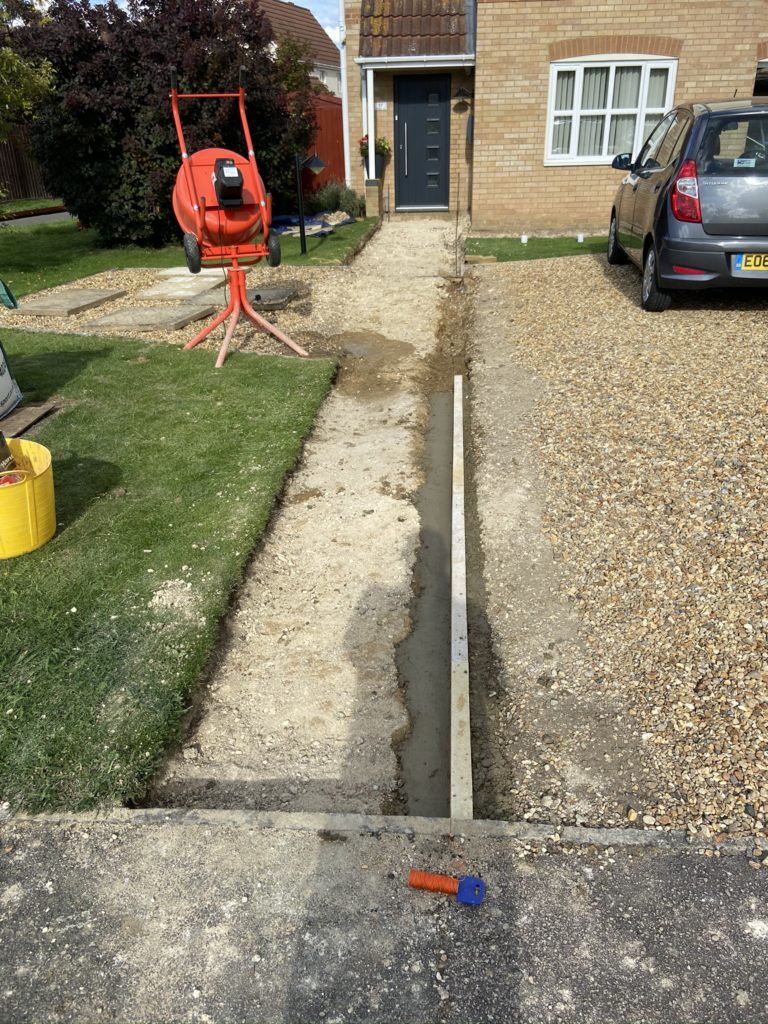
Concrete edging cemented into place, taking time to follow the string line for both height and straightness.

Getting the sand level correct

Once the edgings had set, we laid MOT1 and used a friends ‘Wacker Plate’ to compact this, before applying a 50mm layer of sharp sand.

My spirt levels height was the same as a pave block (50mm), the base sand was compacted and I used two lengths of 25mm galvanised electrical conduit as runners which were embedded in the sand.

The level was then used to scrape the sand using the conduit as rails, adjusting the depth until the sprit levels top edge was 10mm proud of the edgings top, this was to allow for the bricks compaction at the end of the laying process so they lay flush with the edges.

Where the blocks butt up to the lawn, I used Corten steel edgings, as these are very thin, strong and will last for decades.

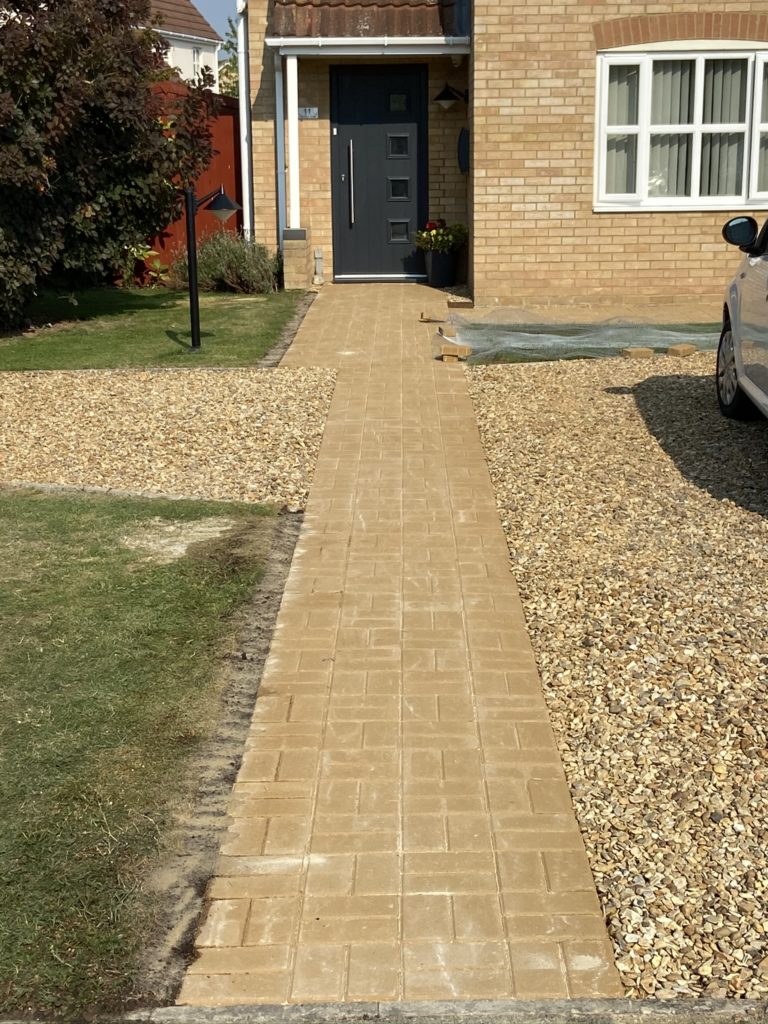
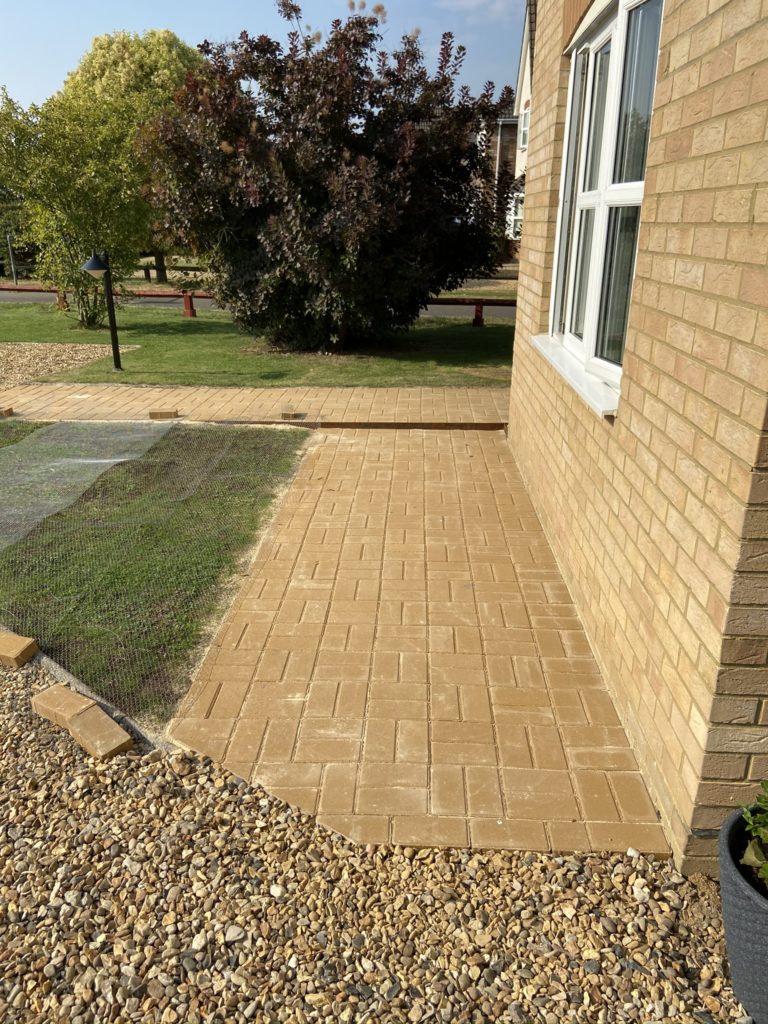
With the blocks laid, the ‘Wacker Plate’ was again used, after a liberal layer of kiln dried sand was added, to vibrate the sand into the gaps and effectively ‘lock’ the blocks in place.

The lawn was then reseeded, hence the mesh.

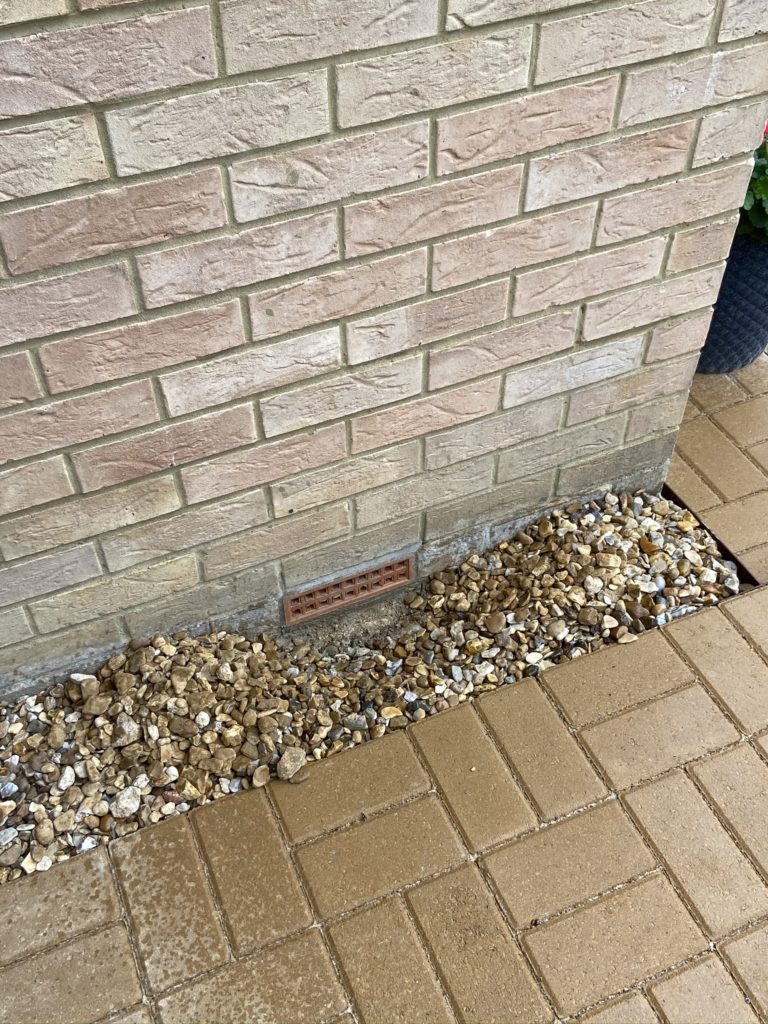
One good thing to come out of this apart from a path, is that the house builders had simply filled an air brick hole up with gravel which was below the paths grade, so hidden.

This was sorted very quickly with a new air brick installed, but the builders should have known better, but the quality of construction in certain areas is questionable!

Conclusion

The weather was very kind to us when we were doing this project and their was no rush, so it turned out to be a pleasant job to do, still physically hard work, but it does look good for an amateur job, (although I do say so myself :-))

Replacing Rotten Porch Support Post

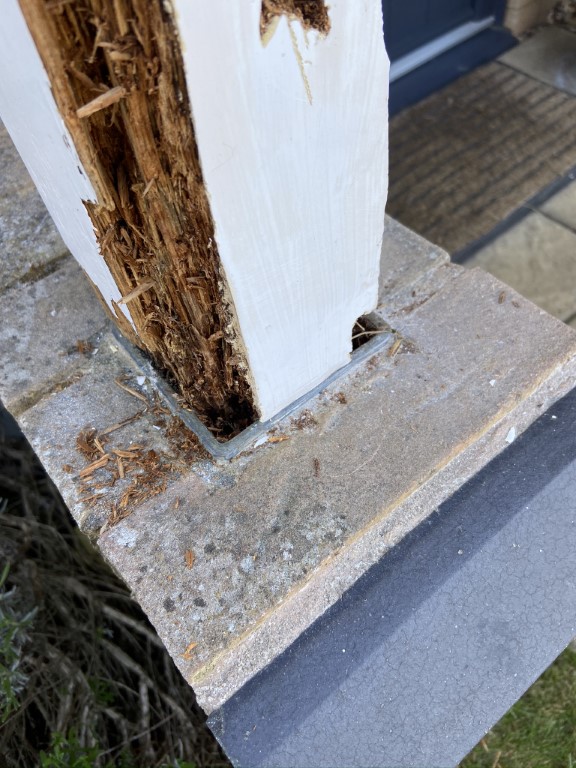
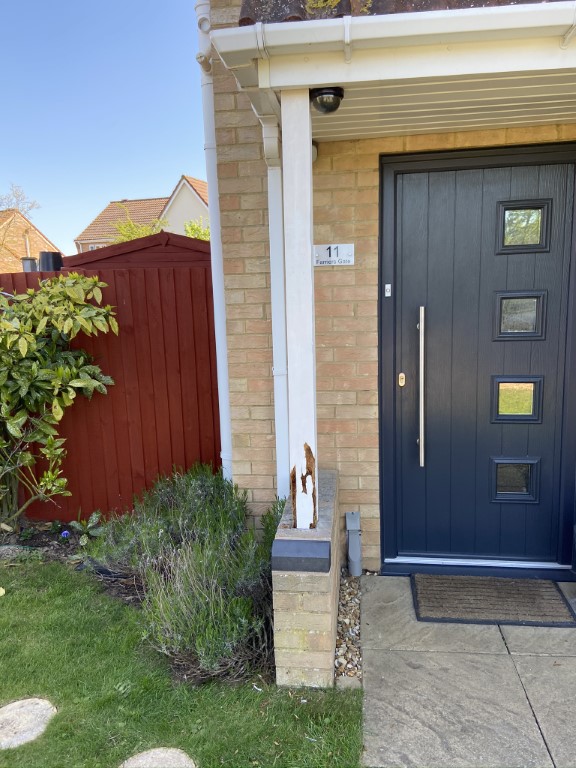
It all started so innocently, I thought I would give the post supporting my porch a coat of paint, so armed with a blow torch and scraper I started to prepare the post until my scraper sank into the soft wood at the bottom of the post 🙁

At this point I could have stopped and simply painted over the rotten wood, but as it was a nice day I got a screwdriver out and explored the extent of the rot.

This ended up being quite extensive.

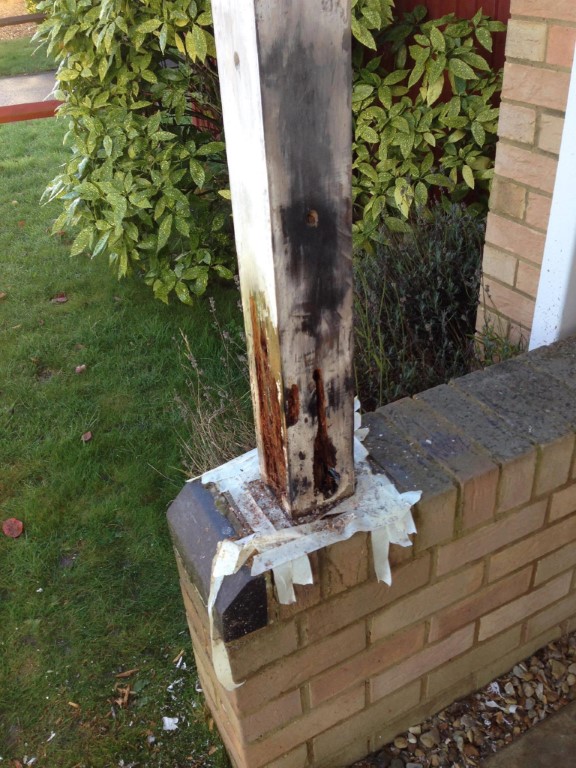
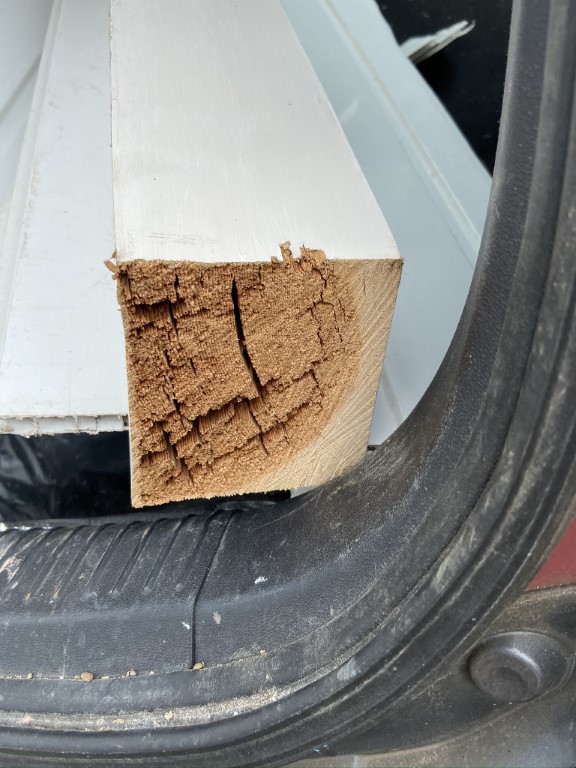
I scraped out all the dead wood and tried to figure out how it had rotted, the post is inside a galvanized shoe, and all I can imagine is that water has sat in the shoe and ‘wicked’ up the post and rotted it.

Once it was back to decent wood and left to dry out, I used Ronseal exterior wood filler over a number of sessions to make good and finally sand down and give two coats of gloss.

Once painted up it wasn’t a bad job and I was really pleased with how it turned out.

Rolling the clock forward 4 years and as my first retirement project and in the March 20 lockdown, I thought I would spruce up the front of the house starting with painting the post, so out came the sandpaper.

Once I started to rub the paintwork, it was obvious that the wood was soft in areas where the filler wasn’t previously and it was at this point I decided to bite the bullet and replace the post.

The unknows were how is the post secured at the top and at the post base also could I replace the post with little or no damage to either the wall or the UPVC barge board and cladding.

The two thing I knew was that the porch will need support once I remove the post, and the second thing was that I’m rubbish with wood so splicing into good wood on the exiting post was out of the questions.

Very little information exists about the construction method used to support the porch, hence this blog to help others who have a rotted post problem.

Before starting I sourced and bought all the materials which I thought I needed.

The replacement post was a Stop Chamfered Porch Post 2100mm x 95mm x 95mm and bought online from RMJM Joinery Ltd and cost £56.97 including shipping.

The part number is SCPP2100 and is engineered timber meaning it is two pieces of wood laminated together giving a high strength, warp resisting, structurally sound post with no knots.

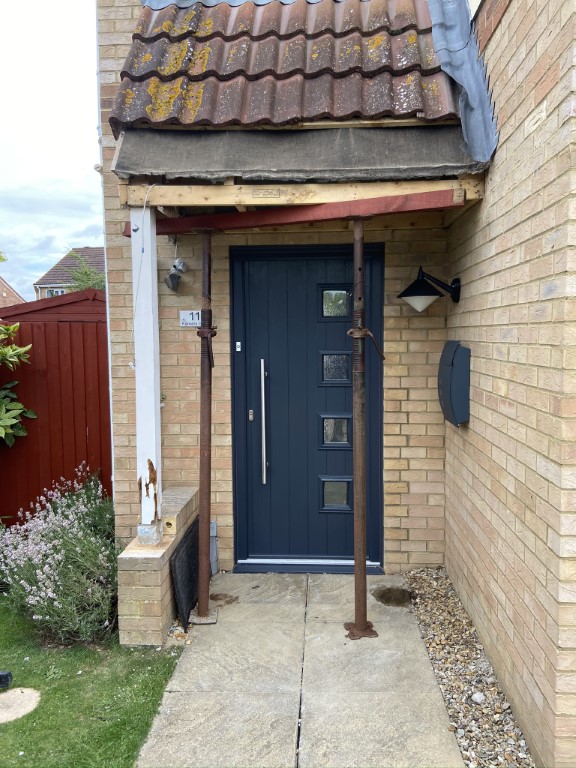
I bought a couple of used Acrow props of Facebook marketplace for £20, which was cheaper than hiring and started to figure out how I was going to do the post swap with minimal damage to the UPVC facias.

Checking the online forums, the general consensus was that getting the polytop pins out which hold the facias on was impossible without damaging the soft surface finish.

I ordered a small number of 30mm and 65mm polytop pins from ebay for £5.70 and looking for replacement UPVC cladding, I couldn’t believe my luck that a wholesaler who sells to the public was based in the town.

AJW Distribution had everything in stock I needed to replace anything I would damage, also they were very friendly and helpful.

I started by removing the guttering and porch roof tiles so I could figure out how the post is attached at the top, trying to save the UPVC was futile, so off all that came too.

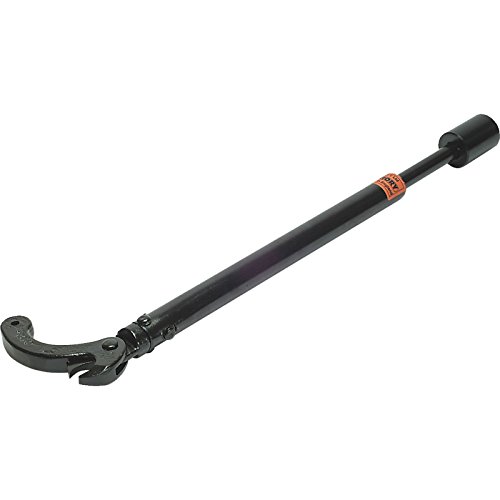
Before the post was cut, the porch was supported by a substantial diagonal brace and bricks enclosing the base of the post removed. Using a nail puller, the nails at the top of the post came out easily, leaving the post to be cut and removed.

Nail Puller

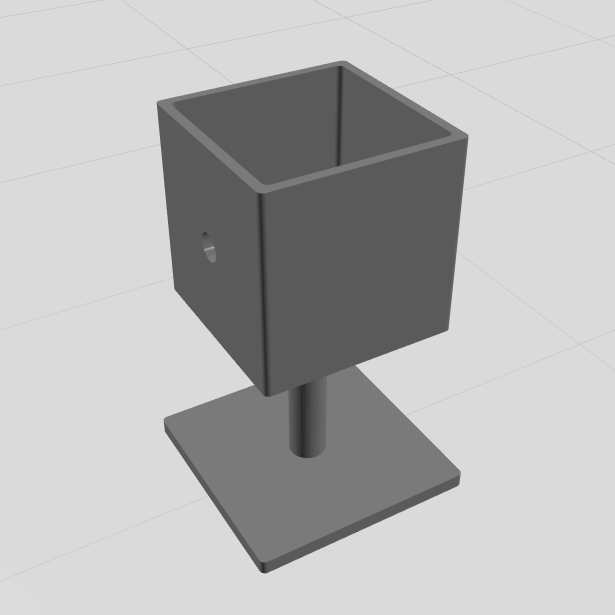
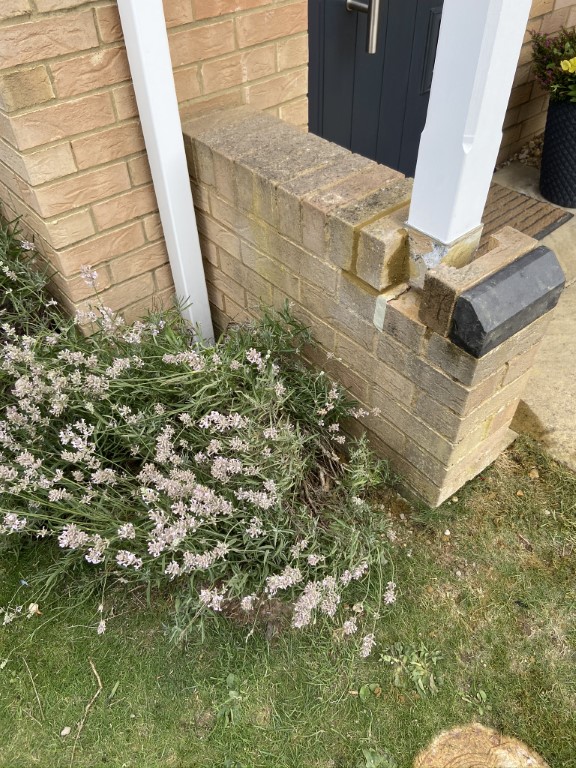
The post base was seated in a galvanized shoe, once the soldier bricks were removed it exposed that the shoe base was sitting about 10mm off the second course of the brick wall.

Once I pulled the shoe out of the wall it exposed a locating spike which must have been sitting on the third course of bricks and all the weight of the porch was being transferred as point loading through the spike to the bricks below, a really rubbish construction.

Checking online, it look like the shoe has been modified as the base of the spike should have had a plate attached to spreads the loading, but I might be wrong.

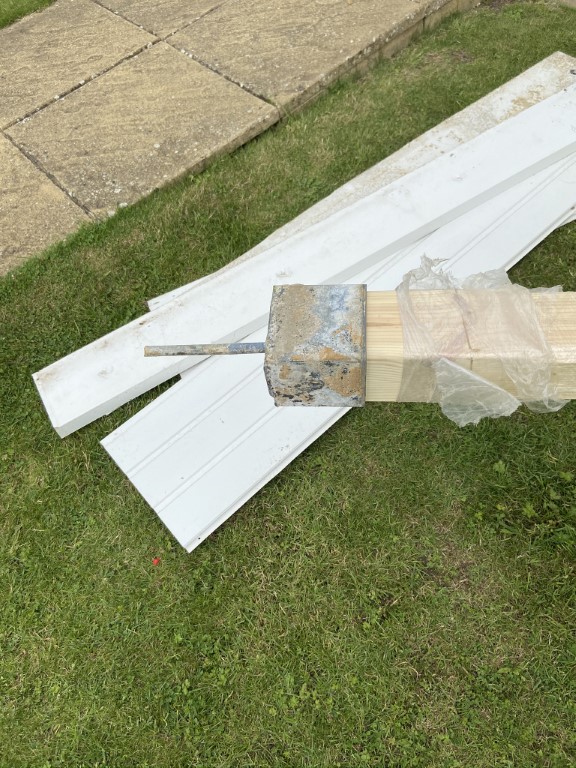
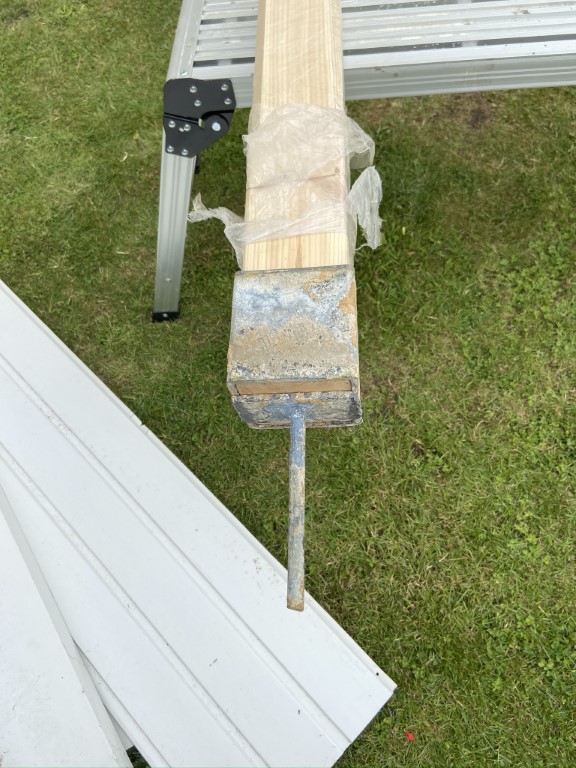
The picture below shows the shoe fitted to the new post, the spike had been bent during original installation and I can only assume this was done in order to get the post level and true vertically.

Picture showing galvanized shoe on new post

Once the post was cut out, it was quite a job to get the residual wood out of the shoe to allow me to reuse it.

The picture shows the post damage over 300mm up from the base where I made the cut in removing the post.

The new post was an ‘interference’ fit into the shoe as I didn’t want their to be a gap allowing water to ingress between the post and the shoe, this meant I used a big hammer to knock the shoe over the post, it certainly wont come out in my lifetime 🙂

Fitting the new post back was very straightforward, once measured and cut to length, the post shoe spike was located back in the gap in the wall and the top of the post securely bolted at the top on both elevations.

I had packed the shoe base with mortar as it was being installed to spread any loading. I had to get two new bricks which unfortunately don’t match the existing (London Brick Company, Honey Buff), but I kind of like that as it shows the post has been changed.

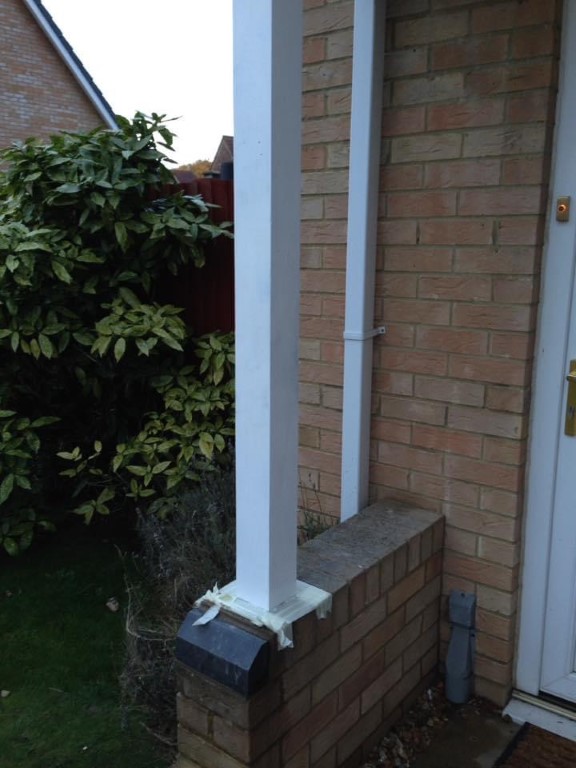
In the picture above you can see a strip of masking tape, this is covering a piece of 15mm copper pipe flattened into an oval shape which goes under the shoe and will act as a drain should water try and collect at the base of the post again.

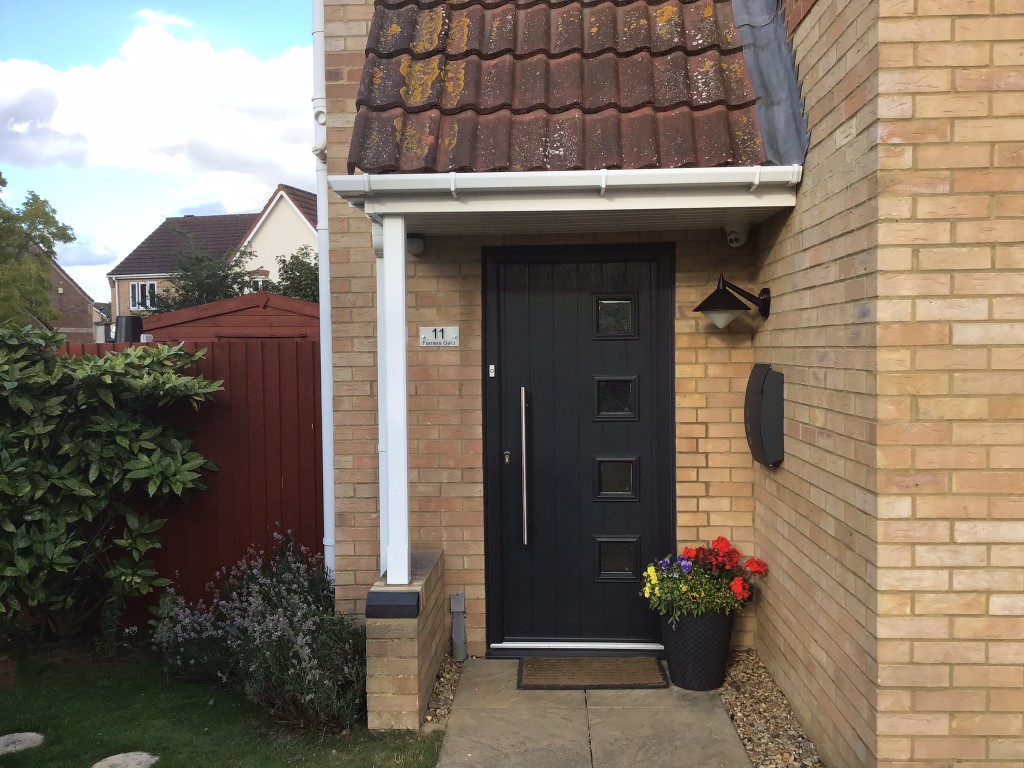
The finished job, I replaced all the facia boards and cladding, including adding cladding edges, which was a significant improvement on how the house builders finished the porch, the overall cost was less than £150.00 including undercoat and top gloss paint.

Not much to look at once its all done, but I know it will last another 20 years and hopefully longer.